Showing posts with label Karibu Safaris. Show all posts

Friday, November 14, 2008

Africa cheered for Obama


with photos of Sandy, chef Class and guide Borobi on the Karibu mobile safari during the time of not knowing who won the presidential election, plus a photo of me celebrating Obama at Dune 17 in the Namib Desert at Sossusvlei.

MAUN, BOTSWANA – We were in the bush searching for lions when the polls opened on the East Coast for the U.S. presidential election.

As we bounced along the sandy roads of the Moremi Game Reserve in the Okavango Delta, I turned to my friend visiting from Austin, Texas, and said, “They’ve started voting.”

What would the day bring?

In Botswana, nicknamed The Thirstland for its vast expanse of semi-arid desert, Nov. 4 brought this country’s greatest blessing from above: pula. The word means rain, money and “Cheers!” – especially cheers for the president. From my perspective, such a blessing was perfection on America’s election day.

We didn’t find the lions, because the season’s first crashing thunderstorm rolled over the delta, offering relief from temperatures of 47 degrees Celsius and water to parched animals. With no Internet, telephone, television or commercial radio, I and Dr. Sandy Garcia, an emergency room pediatrician and an Obama fan, were unplugged from the election’s moment-by-moment, red-blue-state updates.

Unplugged has been my mode of living for most of the months I have been in Africa, on sabbatical from my job as deputy editorial page editor at The Bee after falling head over heels for the African wilderness. Never before have I been so unaware of the world’s events, not from lack of interest but from lack of media in the bush. I found out two weeks after the fact that Russia had invaded Georgia. I peppered tourists as politely as possible for scraps of details about the U.S. presidential election, and each time I flew to Maun, I rushed to the Internet to try to catch up. It seemed an impossible task.

Time and again I have relied on local Botswana friends to relay the news, mostly by word of mouth. They’ve done so, even using the old-fashioned walkie-talkie-style radio at Desert and Delta Safari headquarters in Maun to provide me updates during the primaries. And, of course, I voted absentee in October from Cape Town – by fax.

The interest here in the election has astonished me. “A Black man in the White House?” was the front-page headline of Maun’s 12-page, weekly The Ngami Times (CQ) on Oct. 31. “That’s the question on everyone’s lips,” according to the story.

Wherever I’ve traveled on the continent, Africans -- white, black, brown, mixed -- have been pulling for Obama. (There was one exception: a white Zimbabwean who told me if “Hussein” were elected, it would be bad for the hunting business; wealth would be redistributed, discouraging rich Americans from booking hunting safaris.) In Zanzibar I met Masoud (CQ), who started a bona fide Tanzania for Obama movement by scrawling his support for Obama in ink on a Sebego shoe.

Masoud said Africans like the fact that Obama’s father was Kenyan. “But that’s not the main thing.” Hope is, he said. “My father insisted on honesty, sincerity and respect. I see that Obama embodies all those things my parents taught me.”

In September a flight attendant on Air Botswana pointed to the in-flight magazine and whispered proudly, “I’m a supporter of Obama. And that’s OUR Obama.” The magazine cover featured Botswana’s new president, Seretse Khama Ian Khama (CQ), the son of what is referred to in historical terms as “a marriage of inconvenience” between a white British woman and an Oxford-educated black tribal chief who became Botswana’s first president after independence in 1966. Many attribute Botswana’s racial harmony in part to the nation’s having had an interracial couple as founders, its version of George and Martha Washington.

Sandy and I rolled into Camp Moremi just before 11 a.m. on Nov. 5. Desert and Delta’s Munihango Limbo (CQ) walked toward me with a big smile. He had been watching election returns off and on all night in Maun before his flight to the lodge that morning.
“Obama won!” he said.
“Is it official?” I asked.
He said it was unofficial. Rats. After the 2000 and 2004 elections, I hesitated to jump to conclusions. I rushed to the radio to talk to Mos Bashe, in charge of lodge logistics for Desert and Delta in Maun and someone who had followed the campaign’s every twist and turn. It’s official, he told me. (Upon my return the next day to Maun, Mos, beaming and without a word, would throw his arms around me in a bear hug in celebration of the win.)

That Wednesday night at the lodge in the bush, Sandy and I were the only Americans, but the other guests – Europeans and Australians – were quick to sing out, “Brilliant show! Good job! Congratulations!” It was a fine celebration, even prompting me to make a speech and offer a toast.

In the days that followed while I traveled in Botswana and along the coastline and desert of Namibia, government officials at border posts, customs officials, receptionists, gas station attendants, waitresses, police officers, bar tenders – you name it – they all talked about the election. “Congratulations to you!” they cried, as if I had just birthed a baby. Thumbs-up was their universal greeting in honor of Obama.

“Obama is the 44th president of the Republic of the United States of America,” said Galerone Galeitsiwe (CQ), a truck driver in Maun. “Congratulations to you. It means the end of apartheid. Black, white, we’re all the same. Asia, Africa, America, we’re all the same.”

The view from Africa is an enlightened one. There is audacity in Galeitsiwe’s statement, echoing a sentiment of real optimism in the places I have traveled on this continent that America remains a beacon that stands for dreams, possibility, opportunity.

“If Obama can, we all can,” one East African told me.
To which I say, “Pula! Cheers to the president.”

Thursday, September 18, 2008

No reality show could beat this: Maun Life


Maun, Botswana
September 18, 2008
(with photos of a Maun sunset on an August boat cruise on the Boro River and of Audrey, who didn’t seem to mind Maun’s reputation when she visited from Texas last month. The boat driver is James Howard, a motorcross fanatic British fellow who can’t get enough of Maun.)

While Kelly swims the pristine waters of the Indian Ocean at Zanzibar, I am in hot, dusty Maun back into the swing of my volunteer work.

I am looking on the bright side of having left a tropical paradise a week ago.

Maun is an outpost from days gone by, quirky as can be, teeming with legends about “characters.” And the thing is, some of the characters are still alive and walking past the same goats and donkeys as I do most days.

I haven’t seen him myself, but my friends at Karibu Safari say you can pitch up (a South African term for show up) at the bar at the Okavango River Lodge and see the guy without the arm. A lion ate it. The former national beauty queen from South Africa might be there at the same time. She’s missing a good part of her calf, thanks to a hippo attack.

Last night a gristled, bearded man at River Lodge was sitting at the table where my friends were. Kirk, one of Karibu’s owners, told me that the guy has two master’s degrees and a Ph.D. from universities in Germany. He came to Maun and never left, making his living by running a marketing campaign for a safari company. It turns out that a woman I met a few months ago in Savute, a graceful slip of a gal who drives a huge truck and trailer filled with camping equipment for her husband’s private safari company, is a former French horn player in the London Philharmonic Orchestra. Her husband used to be the guide for Lloyd Wilmot, who set up the tented camp 30 years ago that eventually became Savute Safari Lodge. Lloyd is one of the many children of Bobby Wilmot, famed crocodile hunter who died in 1968 after a black mamba bit him in the face. (Lloyd’s sister was attacked by a crocodile that left teeth marks in her boat but not a scratch on her.)

Lloyd is still around somewhere in these parts, and he is known to be fearless. I saw it myself: He cut a hole in the wall of his Savute house beside his bed. He’d put food on a ledge there for the lions; from his bed he could turn his head to the right and see the lions inches away and take their photos.

Friday night I was at the Bridge at Backpackers, the place Prince Harry and Chelsea frequent, when friends pointed out an older bush pilot at the bar. Everyone thinks that’s Lord Lucan, they said, telling me: Go ahead; Google him. Which I haven’t done yet. They said years ago a wealthy British man who meant to kill his wife but killed the nanny instead disappeared before he was brought to justice. Within a few weeks a wealthy British man, very mysterious, pitched up in Maun, to stay. The locals looked at the photos, and they are convinced it is the same guy. And that doesn’t even touch on the CIA stories I’ve heard here, but those are for campfires back in the U.S.

If you go to www.jacanaent.com, you can see a truly grab-bag of a Web site. The businessman in town who sells tasers and Leathermen and sandals and embroidered safari wear for the lodges’ staff and my can of “Gettem” quick defence spray has compiled photos and the history of Maun, for all the world’s viewers.

He writes of Maun, population 94,698 in the 2001 census: “This magnet for rural people eager to find work has been described in many different ways, from being ‘a place too far from civilization,’ tsetse fly infested (in its early days but now eradicated) rumbustious, the last frontier and ‘a dreadful hole,’ to the far more delightful and appropriate, the ‘Place of the Reeds.’’’

You can see I fell short of selecting Tuscany for my sabbatical year. But I can guarantee you that in Tuscany there are no classified ads in the local newspaper proclaiming the need for herdgirls and -- should any of my embattled journalism friends need a career change -- crocodile skinners.

I like the word “rumbustious” to describe Maun. It fits the can-do attitude so prevalent here, the best example of which I found on the front page of The Ngami Times on Friday. “LEATHERMAN SAVES PILOTS: Four hour drama in the air.” A female pilot and her husband had been flying a Cessna 210 to Jao Camp in the Okavango Delta to deliver supplies when the right wheel locked. For four hours, they did everything they could think of to free the wheels, including dumping freight and making three dives from high in the sky to see if they could get the wheels to work. Nothing helped, despite all sorts of instructions from all sorts of people on the radio.

How appropriate that in Maun finally came the magic words from one of the flight company’s’ ground crew: “Do you have a Leatherman?”

When the man in the air said yes, he was instructed to cut a hole in the seat above the undercarriage and then into the floor of the plane. The guy told the newspaper he used the Leatherman “like a tin opener,” and reached through the hole in the floor to free the wheels.

“I was more concerned about saving the lives of my wife and myself than losing a hand,” he told the newspaper.

David and Cathy Kays took out a quarter-page ad in the newspaper thanking every last soul who helped them land the plane, including “To the people of Maun, friends and family for being behind us in spirit and prayers while we circled overhead and for their loud cheering when we made a safe landing.”

They wrapped up their ad with a tribute to Maun, “a very special place with a community spirit that is rare to find. It is thanks to the above that we were able to come out of a nasty predicament. You all gave us the strength to be calm and practical.”

In Botswana, that part about being “practical” means they had been instructed with those all-important, ubiquitous words, “Make a plan.” They did, with flying colors. And now they will be among Maun’s legends, not as quirky characters, but as the latest names on the roster of can-do Africans. Makes me proud to roam around this rumbustious place of reeds and heat the likes of which could melt your toenails.

Tuesday, August 5, 2008

She don't know jack


Aug. 4, 2008
Maun, Botswana

I started my day with Jungle Judy, the woman who once single-handedly pulled a python out of a trough. She did it herself after the gung-ho bush guys accompanying her on the mission collapsed into motley uh-oh bush guys and scattered like roaches at the flip of a light switch. When that thick python turned out to be longer than Judy was tall and started wrapping itself around her, only then did the chagrined men come back to pull the snake off and tuck it into a sack, away from the chickens it had been menacing, not to mention Judy.

Yes, Judy Phillips of South Africa and now of Maun, age 30-something, is a pint-sized, ballsy sparkplug, and it is thanks to her serving as my broker and intermediary that I now have wheels. She’s the food and beverage manager for Desert and Delta’s lodges. And she took time out this morning to attend to one final detail of my rented Toyota Surf. She insisted I needed a hydraulic jack, because Kobus Lubbe, the owner of the Surf and one of Judy’s best friends, forgot his in the Central Kalahari.

Judy bought a replacement hydraulic jack this morning, and she made Nick the DDS mechanic check whether it was big enough for the truck. With an unlit cigarette hanging out of his mouth, Nick got down on the sand and began coaching me, cigarette still in mouth, on how I would use the jack if I had a breakdown or a punctured tire, or, as they write in Botswana, tyre. I was standing beside him in my skirt and bending down occasionally to appear interested.

If you saw the monstrous size of “tyre” that I would need to wrestle to succeed in changing a tire, you would agree it is hopeless. I told Judy I would revert to my tried-and-true girlie method that consists of standing on the side of the road and looking tearful; usually men stop in a flash, but I guess this is Botswana where it is always possible that the only life form that might pass a stranded motorist is a plodding donkey or a herd of goats.

“Murphy’s law,” Judy said to me. In other words, if I had a jack I would probably never need it, but without one I was as good as a Maun dirt walker again.

The jack she bought me was too small, so off we motored in her Surf to the Motovac, the auto-parts store, possibly the most impressive of all Maun businesses in size and sleekness. You see everyone you know at the Motovac, which gives me the distinct impression that I might be needing that new jack at some stage of the journey.

Turns out that everyone’s vehicle is always breaking down. But this village is lousy with bush mechanics, so even if the vehicles date back to the Stone Age, the mechanics get them rolling again. And lucky for me I live at a safari headquarters where mechanics arrive every morning promptly at 8 a.m. This I count as yet another blessing.

I was waiting in the Motovac parking area when, to my delight, two tiny folk came running for me. Jabu and Fiki! They were waving and wanting to give me a hug. The two little ones go to Bana Ba Letsatsi, the day center for street kids and at-risk children where I have been volunteering lately. Bana Ba Letsatsi means Sunshine Children, and the faces of Jabu and Fiki tell you what the mission is about. (Their mother was nearby; don’t worry that they were hanging out at the auto-store by their lonesome.)

Bana Ba Letsatsi is the little nonprofit that could. It has 226 children on its register. Nowhere near that many show up every day, but children drop in and out – for a hot breakfast or a hot lunch, showers, a place to wash their clothes and a safe environment to read, play sports, do crafts and, yes, watch cartoon videos. You will see photos with this entry that give a glimpse: Jabo/Fiki; Terence, who has a scholarship to the private school where my landlords’ son Kyeren goes and where I attended the barn dance (Terence won a reading award last week!); and Terence again in the office with Matthew Harris, a volunteer from London; Fiona Miller, a Brit who is the center’s executive coordinator; and Oupha, who serves as receptionist and go-to staff member.

I don’t have photos yet of the Botswana classroom coordinators and counselors who work here or of the kitchen staff that makes sure the children receive big helpings of warm food. But they are on hand to do whatever they can for these needy children, many of whom have been skipping school or were sent out into the streets to beg by their parents or, worse, live in homes where abuse is rampant. As far as I can tell, there’s not much happening throughout society to address the abuse, but Bana Ba Letsatsi does what it can to provide the children with a safe place and a daytime refuge. Matthew picks up some children in a combi (a big minivan) at daylight to make sure they go to school and drops them off back home in the late afternoon. An accomplishment can mean providing a tent for a homeless child or moving children away from the bad influences in town to what amounts to a foster grandmother’s house on the outskirts of Maun.

The center receives donations from the European Union and kind-hearted people around the world, most notably a Brooklyn woman who sits on Bana’s board and sends money from her foundation. Tourists mail checks. Others drop by occasionally and dump contents of their extra suitcases. Last week, books, eyeglasses, clothes, children’s Tylenol, pads of paper, colored pencils, Band-Aids and, oddly, Pine Sol in plastic bags lay in a heap on the floor waiting to be sorted. Someone had stopped in between flights and left a much-appreciated bounty. The center has a 60-year-old Peace Corps volunteer from Alaska attending to finances. Local businesses, a few of them anyway, including Desert and Delta, have lent support, and a big hope at Bana is that more local businesses will embrace the center in the coming years.

I have always loved children, and during this sabbatical year I am meant to be in their company. I’m not out to change the world here. I do simple things, but the interactions with the children go a long way toward feeding a tired soul accustomed to running on newspaper deadlines instead of playgrounds and sitting at computers instead of see-saws. Each one of the little ones deserves my thanks. I push Fiki on the swing. I help Rose practice her reading. I listen to Terence read his books for his homework.
During the school holidays a few weeks ago, I played ball with the children at the sports complex and on another day I went with them on a hike at the nature reserve. Like any good safari-goers, we hoped to see the zebra or giraffe at the reserve (no predators at this park), but, like many good safari-goers, we had to settle for a couple of impala. On another day, my task was to separate all of the medicines in an office cabinet and organize them so that little kids wouldn’t run the risk of being given a dose of over-the-counter drugs meant for teenagers and adults. And on yet another day I helped Fiona write a letter asking for support to make a dream come true: The woman in Brooklyn has invited Bana children to New York in April 2009 to see the educational and cultural sights and to be on hand for a fundraiser for Bana. Fiona hopes that 10 children might be able to go, with 2 staff members accompanying them.

But New York is across the globe; despite free accommodations the expense would be staggering. And yet, even in faraway Maun, dreams for those with tangibly little cause for hope are big and stoked by the smallest of gestures. Just look at the smiles. You’ll see resilience enough to humble any world-weary visitor.

And, as for the bush mechanics: When I mentioned to my landlords last week that Bana’s Land Rover Defender had broken down yet again and Fiona was heartsick and confused about whether to spend 15,000 Pula to have it fixed or whether instead to chuck it, my landlord Stuart said, no way, his mechanics would have a go at fixing it, probably for free or at least for a lot less than a local garage was charging.

Today he had the Defender towed to this property. The Karibu Safari mechanics arriving outside my door at 8 a.m. tomorrow might not know it yet, but they have a noble job waiting for them, one that will help ‘the little center that could’ keep rolling. And that is fine news indeed for Jabu, Fiki and the rest of the Sunshine Children.

P.S. Want to see how high I can swing?

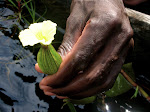
A magical flower

A magical flower
The guide squeezes this flower and it squirts water like a water pistol

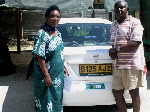
Cathy and Joe Wanzala

Cathy and Joe Wanzala
They couldn't wait to paste the Obama sticker on their car

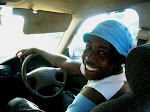
My main man

My main man
Ernest is my trusty cab driver who blasts music as we make our way through Gabs

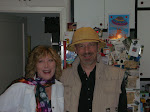
Ted Thomas, man of intrigue and style

Ted Thomas, man of intrigue and style
My friend, Ted, and his wife, Mary Ann, hosted a Safari Send-Off for me in Austin and treated me to a special mix of African music that already a UB student and a professor want to download.