Saturday, July 12, 2008

Another reminder of Xugana sunsets


Here's what I won't forget.

I go out walking...before midnight.. out in the moonlight

July 12, 2008
Maun

When I lived in Austin a documentary caught my fancy: “Hands on a Hard Body.”

The joke, of course, was that the title depicted what might come to mind as available from a dark, sealed-off corner of the Blockbuster store, or, worse, at a gritty venue off Times Square where you wouldn’t be caught dead by anyone you knew. Fooled us, every one.

“Hands on a Hard Body” was cinema verite, darn right, but it was about an annual contest in Longview, Texas, at the Nissan dealership. The documentary captured the battle of wills: Contestants vie by standing until they drop – sometimes in a matter of hours, sometimes in a matter of days – trying to keep a hand on a vehicle. The sleepless, dazed, incoherent winner – the last one left standing with sore feet and with a numb hand on the hard body -- takes all: the spanking-new, Deee-luxe pick-‘em-up truck.
Ain’t she a beaut?

As a previous winner, man of the black cowboy hat with a porn-star mustache to match, summed up the competition, “It’s a human drama thing.”

I recall a skinny, ruddy-faced boy of about 20 describing to filmmakers his inclination to join the contest.

“You can do ANYTHING with a pickup,” he said.

He was consigned at the time to driving a VW bug on the backroads of Louisiana -- if I’m remembering right -- which must be a little like going hunting with a candy-colored letter opener. He had big dreams of being able to travel where he wanted to travel and do what he wanted to do and, best of all, haul whatever he took a mind to haul.

He didn’t last long in the competition. The Hispanic woman who listened to gospel music through her earphones and praised the Lord with one upraised hand (the other on the pickup, of course) clocked a better showing. So did the woman missing some front teeth who’d practiced in the noonday heat outside her house with its 3-ton air conditioner to get ready for the competition but ultimately stomped off in a pure-D butt-kickin’ huff, complaining how the danged contest was rigged because the judges hadn’t disqualified the ones who lifted their hands an inch or two here or there. What are you, judges – blind?!

But I have to say the ruddy-faced boy got it right. It takes living in Maun, Botswana, to walk a mile, or four, in the boots of that beetle-driving boy.
I find myself walking a lot these days, up my sandy road, along the main road, which they call the “tarred road,” to the Internet cafes, to the Bon Arrive, to the Spar grocery to the FNB bank. You name it. I’ve hoofed it already.

I look with yearning at the safari trucks barreling past me, kicking up another coating of sand and dust for my hair, of late a new color thanks to L’Oreal in a box. I admire the Toyota Hilux with a passion, not to mention the Land Rovers, miniature Nissan pickups and all-purpose Surfs. Coveting is a bad thing, right?

For the first time in my adult life I am without wheels. And for a woman who has been known to drive six hours from Kentucky to Washington, D.C., for a Sunday brunch, this is a sobering predicament. It’s high season in the delta. Even the local yokel City Car Concepts has no car to rent me, never mind the extortionist prices.

Trudging along in my cloud of dust on the road’s shoulder, not unlike Charlie Brown’s friend PigPen, I see all of the rugged people of Africa, men and women, white and black, hauling ladders, truck tires, camp supplies, even people, in the back of their trucks, and I feel like a teenager who’s been grounded. I cut short a perfectly lovely evening with a Motswana guide at 6 last night on account of my concern that my newest taxi driver, Phil, would refuse to ferry me down the sandy road after dark.

I am an oddity. A toddler on the side of the road with her mother pointed at me in amazement as I slogged toward the two of them, hoping to see a taxi at any moment. “Makgoa!” said the tyke.

I got my guide friend to explain it to me: “White person,” interchangeable, he said, with “Customer.” Nothing derogatory about makgoa. Just a fact.
And so I trudge on, understanding with a newfound depth of empathy what it is to long for a truck – any old battered model would suffice -- in the sands of Botswana. I could do anything if I had one.

Friday, July 11, 2008

The owner's home and my view


Here are a couple of more photos that Blogger refused to let me load for the posting below....

Survival 101


July 11, 2008
Maun

Today I unveil photos of my little cottage, home to mystifying night sounds and spiders of remarkable size. I let them be as I crawl under my bug net from REI, tucking myself in tight. The thought of the critters crawling on me makes me shiver. I stuff in my earplugs. The less pitter-patter I hear, the better. But that means I miss the screech of the barn owl, the hair-raising cry that sounds like brakes applied just before a car wreck.

I saw that owl, finally, yesterday in full swoop for only an instant but a magical one. I hope it got a rat -- a fat, hairy, juicy one.

You can see my home is fine – clean, equipped well and sunny. It even boasts a red wall in the sleeping area and a purple one in the bath. (On the table sits the excellent new book by my dear friend and former colleague, Bill Bishop, and the esteemed Bob Cushing. “The Big Sort” is about our self-selected, lifestyle segregation and its implications for American political life. It’s the talk of NPR, the Economist, the Wall Street Journal and the Washington Post, and it’s well worth your time.)

The true storybook home – the green one with the thatched roof – belongs to Kim and Stuart and their 10-year-old son, Kyeren. To my delight, their Jack Russell terrier named Jenna and new puppy, Sandy, wander over to visit me most days. So does Kyeren, always in search of a banana.

Yesterday he regaled me with survival tips for the bush, a proper topic of discussion for a third-grader whose parents helped found People For Wildlife in South Africa and who now run their own mobile safari company.

“Do you want tropical rain forest, savanna or desert?” Kyeren asked.

“Well, I don’t need rain forest around here. I need something useful like for that out there,” I said, pointing to the blasted, endless sandy road that is my nemesis when it comes to getting back from town. (I’ve still not managed to find wheels. Taxi drivers give me what-for when I tell them to keep driving; we’re almost to my cottage. Needless to repeat, I am not living a big-night-out-on-the-town kind of life. I might as well be living by kerosene lantern, on the Abe Lincoln schedule.)

Kyeren began to expound on how in the desert the first thing to do is rip my T-shirt and wrap it around my head to prevent sunstroke. I then must go in search of shade and water, a slog likely to be fruitless but one I should undertake with optimism. Otherwise, I must harvest my sweat, but I’m not clear on how exactly to do that.

Now it’s time for my knife, or without a knife, a stick or stone. Kyeren inspects my Swiss Army knife and concludes there is quite a lot I can do with that piece of equipment. Once upon a time, pre-9/11, immigration officials threatened to confiscate the knife in Cairo. Considering my current and possibly imminent harrowing circumstances, I am relieved I talked them out of it.

I must kill a snake, cut off its head and then skin it. I then will lay the innards on rocks to cook in the sun, a perfect spot that Kyeren assures me will heat to 56 degrees centigrade.
By this time I am making faces at him.
“Yuck. I can’t do that,” I protest.
“Well, it’s bugs then,” he said, skipping forward to menu option number 2.

Or if I’m fortunate enough I can hunt down a hare, cut its head off first, then slice it from neck to groin, gut it and skin it. That would make a good dinner, too, he said.
I could tell Kyeren, a blue-eyed towhead who looks more burhead Buster Brown than mini-Indiana Jones, was enjoying himself at my expense.

“You’re probably going to die,” he said, noting that I had announced that too many things are too gross to eat. I surmise on my own that I am as good as the entrĂ©e and the dessert for the vultures, which I envision ready at the instant of my test of survival to jet in for a sure landing on my sissified heap of hysteria and chow down. (Everyone around Botswana says the same thing: “Africa is not for sissies.” Well, hello? Look who’s come to town.)

Kyeren moved on from the food part of survival to the more palatable instruction for building a camp shelter. That merely involved cutting twigs and grasses to build a shelter like the San build. No problem.

Pretty soon I could tell he was giving up on me. Who wouldn’t?
The remarkable fact is that I sit here in my little cottage and feel my heart aching for the bush, the bona fide bush, where it is entirely possible to have survival skills tested. I look at my photos and wonder how can I get back there. Stow away on one of Kim and Stuart's safari supply trucks headed for Moremi? I could easily hide under the canvas. Who would know?

I look at my photos and remember what it was like, only two weeks ago, to wake up to the sounds of wild animals, to revel in the gifts of nature that are all but forgotten in our cities of asphalt and metal. We walk around in a trance, receiving all manner of computerized information, but bereft of signals from the natural world that can soften the relentless static of modern life. Nature can bring us home, to ourselves. At least it has for me.
I sip filtered coffee poured from my new French press, a touch of city life that I savor down at the end of the sandy road. I promise myself I won’t forget.

Wednesday, July 9, 2008

The Office


I am finding it unsettling to all of the sudden have no structure to my days. I'm not complaining. I'm just saying.

I thought you would like to see my office at Camp Okavango, the one I shared with the charcoal-gray lizard who warmed himself on the electrical plugs, with the lesser-tailed swallows flying in and out, with the swarms of papery wasps that landed on our windows inside and with the baboon who liked to stop and stare through the doorway before she shimmied up a tree to shake loose the tangerines.

My days were fully booked, from the moment I unlocked the office before dawn until the instant my head hit the pillow in the tent.

Here comes the bride, again, 25 years later


July 9, 2008
Maun

Gerald and Lally Warren will celebrate their 26th wedding anniversary in August, but, as Gerald told guests in Lobatse on Sunday, they are “still in their honeymoon phase.”

Was my interminable bus ride to attend their 25th wedding anniversary party worth it? You bet it was.

If the uploading on the blog works, you’ll see photos of Lally in a blue shawl and later in her wedding dress, and you’ll see the bride and groom kissing. You’ll see the traditional dancers from the village of Kanye and the Indian neighbors who performed a lovers’ dance as a gift to the couple. The baby is a cheerful friend I made at the party. Her name is Goone – “unto Him” or “unto the one” is the meaning. I wanted to take her home with me, but I had to settle for tending her an hour.

How is it that a couple can stay together more than 25 years anywhere on the globe in this era and in Botswana, where many people opt never to marry at all but insist on having children together? Gerald and Lally say it’s about finding the right person who is, above all, a friend and a spiritual companion, and, according to Lally, it’s about being “a professional coward.” She said neither she nor Gerald would dare make a big decision without consulting the other. That’s not always the case in Botswana, she told guests. Some women find a stranger at the door to announce he is the new owner of her house; the woman’s husband has decided to sell the house and it is news to her.

The anniversary celebration was a tribute to traditions in the Botswana culture and a plea for transformation, to a world in which men and women will be viewed equally and where the Batswana tradition of honoring marriage between one man and one woman for life can be renewed. Gender equality is after all a major tenet of Gerald and Lally’s Baha’i faith. The ceremony was filled with Baha’i prayers and blessings.

Their party first was a re-enactment of a traditional Botswana courtship and wedding. I found myself in the middle of the festivities as one of the actors. Women were chosen to be Gerald’s family, I among them. We wrapped ourselves in shawls under an unforgiving sun. (I must have looked awfully odd with my khaki safari hat pulled below my eyebrows and my cashmere paisley-print shawl from Provence draped around my shoulders. Talk about sweating.)

We had to travel beyond the gates to the house to find Gerald and the men sitting in a kgotla, a circle of democracy and decision-making. The bride was inside the red-brick house. One of the women in my line ululated, and there was a lot of that going on throughout the ceremony. But I don’t know how to do it: Somehow you make a high-pitched sound, vibrating your tongue back and forth as you shriek. I did the usual: I marched in step and kept my mouth shut. It had worked for me during the choir performances at the camps in the bush. It would work for me now.

We greeted the groom, who in theory was negotiating how many cattle would be given as a gift to Lally’s “family” in appreciation for the bride. During the ceremony, Gerald and Lally would stress that the “bride appreciation” has changed for the worse over time; too many young people use it as an excuse not to get married. They complain they don’t have the money or cattle to afford to marry. The anniversary celebration set the record straight: The bride appreciation, as it was in the days of old, can be a promise of cattle (or money) to be paid at any time during the marriage. The important thing is that two people love each other and have their parents’ blessing for the union.

We marched back into the courtyard to “meet” the bride’s “family.” We sat on the driveway on animal skins across from the women of the bride’s family. There was ululating as if in conversation across the divide, while we waited for the bride to come out of the house. This seemed to take a very long time. Or maybe it was the fact I was wearing a shawl in noonday sunshine.

We were told we must sit with our legs straight in front of us. Uh oh. That’s a pose we’re not used to holding for very long in the U.S. unless it’s in yoga class. I slumped. I leaned. I practically fell over on my side. Meanwhile, much older women sat primly, posture upright, legs straight in front, hands clasped in laps. (It reminded me how 15 years ago I had failed to sit still or primly in Korea at dinner tables low to the ground. My legs proved too long to fit anywhere, and I had trouble managing to sit cross-legged for more than 10 minutes at the same time I was fully concentrating on how not to fumble my stainless steel chopsticks and send them flying like missiles at my dinner companions.

“You have VERY long legs!” a little Korean boy announced to me in awe one night in Taegu. I guess that’s why I ended up in Korean strangers’ home videos as the giant big-boned gal come to town.) This straight-legged African seating was even more difficult.

But we managed. Lally came out wearing her blue shawl. Abandoning her air of confidence as a nurse and midwife in her usual life, she sat shyly, like a schoolgirl, in the place of honor. A representative set off to bring the groom. The groom’s group marched into the courtyard, and there were greetings all around, and an announcement that the bride appreciation was 20,000 Pula. Much hoopla! That’s a pretty penny and not a shabby offering from a retired primary school math teacher.

We all disbanded to move to our white plastic chairs. Relief. While traditional dancers and singers from the village of Kanye performed, Lally went into the house to transform herself into a bride in full white “goddess” gown with a pearl headpiece to top it off. One of the great moments of the day was when she was escorted from the door of her house like the leader of a parade, the traditional dancers marching behind with their ankle shells rattling. We guests loved it, and we celebrants were indeed a rainbow crew: Lally and Gerald’s three children and grandchildren; local Lobatse people, rich and poor; white Africans who drove up from South Africa for the day; a mixed-race couple from Gaborone who used to live in Atlanta when he worked at the headquarters for the Centers for Disease Control and Prevention; farmers and physicians alike. We all were witnesses to ritual and renewal.
And like any good ritual, the buffet food awaited and abounded: seswaa (Botswana barbecue), butternut, morogo (greens), pap, samp, salad, maize. I’m probably forgetting something. And we drank ginger beer from a big trash can, and lest you think otherwise, there is no beer in ginger beer. It’s nonalcoholic and delicious in a snappy way. (Baha’is don’t drink alcohol.)

I came away once again honored to know Gerald and Lally and grateful to my artist friend, Mary Jane, in Florida for making sure we were introduced in March. I know more about the culture of Botswana and the secrets of sustaining a marriage than I did a few days ago. Not a bad lesson in any culture and an invaluable reward for a roadtrip.

And how did I return to Maun?
As my friend, Kitso, a guide on time off from Xugana Island Lodge, said to me in a text message by cell phone, “U HAVE 2 B TOUGH 2 B A MOTSWANA LADY.” He was referring to my impatience in the art of bus riding. He messaged me “GUD” when I made it to Lobatse.

On Monday, I sent Kitso an SMS on my cell phone, “AM NOT TOUGH ENOUGH. TOOK PLANE BACK 2 MAUN 2DAY. HAPPY DAY! NO BUS 4 ME 2DAY.”

I am certainly no expert in marriage, but I think I got the overview of long-distance bus riding, along with a few tips: Don’t buy the fried chicken and chips (French fries) the hawkers try to sell you when the bus makes its quick stops. The chicken was probably cooked a day or two before and then rewarmed to release the redolent eau de grease. I didn’t make that mistake, thanks to my seatmate from Zambia’s warning. Truth is, I’m not tough enough to even consider trying the chicken from those corrugated roadside stalls. But I like to think I am.

Sunday, July 6, 2008

Home & Garden notes

How do you dress up a three-star hotel room that has a bug crawling toward your suitcase and the remains of a squashed mosquito smudged above your headboard?
My solution: Tear the stem from a climbing rose bush that holds two perfect white flowers. Place them in the water glass beside your twin bed, the lumpy one that has the sketchy bedspread you don't want to touch.
Now, examine the perfect papery whiteness of the petals and smell the fragrance.
The room feels better already.
Instant interior decoration with a hint of interior illumination.

A magical flower

A magical flower
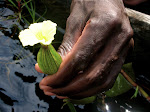
The guide squeezes this flower and it squirts water like a water pistol

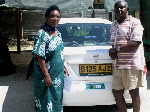
Cathy and Joe Wanzala

Cathy and Joe Wanzala
They couldn't wait to paste the Obama sticker on their car

My main man

My main man
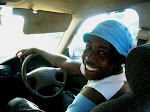
Ernest is my trusty cab driver who blasts music as we make our way through Gabs

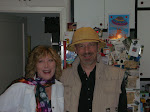
Ted Thomas, man of intrigue and style

Ted Thomas, man of intrigue and style
My friend, Ted, and his wife, Mary Ann, hosted a Safari Send-Off for me in Austin and treated me to a special mix of African music that already a UB student and a professor want to download.