Showing posts with label Baha'i. Show all posts

Wednesday, July 9, 2008

Here comes the bride, again, 25 years later


July 9, 2008
Maun

Gerald and Lally Warren will celebrate their 26th wedding anniversary in August, but, as Gerald told guests in Lobatse on Sunday, they are “still in their honeymoon phase.”

Was my interminable bus ride to attend their 25th wedding anniversary party worth it? You bet it was.

If the uploading on the blog works, you’ll see photos of Lally in a blue shawl and later in her wedding dress, and you’ll see the bride and groom kissing. You’ll see the traditional dancers from the village of Kanye and the Indian neighbors who performed a lovers’ dance as a gift to the couple. The baby is a cheerful friend I made at the party. Her name is Goone – “unto Him” or “unto the one” is the meaning. I wanted to take her home with me, but I had to settle for tending her an hour.

How is it that a couple can stay together more than 25 years anywhere on the globe in this era and in Botswana, where many people opt never to marry at all but insist on having children together? Gerald and Lally say it’s about finding the right person who is, above all, a friend and a spiritual companion, and, according to Lally, it’s about being “a professional coward.” She said neither she nor Gerald would dare make a big decision without consulting the other. That’s not always the case in Botswana, she told guests. Some women find a stranger at the door to announce he is the new owner of her house; the woman’s husband has decided to sell the house and it is news to her.

The anniversary celebration was a tribute to traditions in the Botswana culture and a plea for transformation, to a world in which men and women will be viewed equally and where the Batswana tradition of honoring marriage between one man and one woman for life can be renewed. Gender equality is after all a major tenet of Gerald and Lally’s Baha’i faith. The ceremony was filled with Baha’i prayers and blessings.

Their party first was a re-enactment of a traditional Botswana courtship and wedding. I found myself in the middle of the festivities as one of the actors. Women were chosen to be Gerald’s family, I among them. We wrapped ourselves in shawls under an unforgiving sun. (I must have looked awfully odd with my khaki safari hat pulled below my eyebrows and my cashmere paisley-print shawl from Provence draped around my shoulders. Talk about sweating.)

We had to travel beyond the gates to the house to find Gerald and the men sitting in a kgotla, a circle of democracy and decision-making. The bride was inside the red-brick house. One of the women in my line ululated, and there was a lot of that going on throughout the ceremony. But I don’t know how to do it: Somehow you make a high-pitched sound, vibrating your tongue back and forth as you shriek. I did the usual: I marched in step and kept my mouth shut. It had worked for me during the choir performances at the camps in the bush. It would work for me now.

We greeted the groom, who in theory was negotiating how many cattle would be given as a gift to Lally’s “family” in appreciation for the bride. During the ceremony, Gerald and Lally would stress that the “bride appreciation” has changed for the worse over time; too many young people use it as an excuse not to get married. They complain they don’t have the money or cattle to afford to marry. The anniversary celebration set the record straight: The bride appreciation, as it was in the days of old, can be a promise of cattle (or money) to be paid at any time during the marriage. The important thing is that two people love each other and have their parents’ blessing for the union.

We marched back into the courtyard to “meet” the bride’s “family.” We sat on the driveway on animal skins across from the women of the bride’s family. There was ululating as if in conversation across the divide, while we waited for the bride to come out of the house. This seemed to take a very long time. Or maybe it was the fact I was wearing a shawl in noonday sunshine.

We were told we must sit with our legs straight in front of us. Uh oh. That’s a pose we’re not used to holding for very long in the U.S. unless it’s in yoga class. I slumped. I leaned. I practically fell over on my side. Meanwhile, much older women sat primly, posture upright, legs straight in front, hands clasped in laps. (It reminded me how 15 years ago I had failed to sit still or primly in Korea at dinner tables low to the ground. My legs proved too long to fit anywhere, and I had trouble managing to sit cross-legged for more than 10 minutes at the same time I was fully concentrating on how not to fumble my stainless steel chopsticks and send them flying like missiles at my dinner companions.

“You have VERY long legs!” a little Korean boy announced to me in awe one night in Taegu. I guess that’s why I ended up in Korean strangers’ home videos as the giant big-boned gal come to town.) This straight-legged African seating was even more difficult.

But we managed. Lally came out wearing her blue shawl. Abandoning her air of confidence as a nurse and midwife in her usual life, she sat shyly, like a schoolgirl, in the place of honor. A representative set off to bring the groom. The groom’s group marched into the courtyard, and there were greetings all around, and an announcement that the bride appreciation was 20,000 Pula. Much hoopla! That’s a pretty penny and not a shabby offering from a retired primary school math teacher.

We all disbanded to move to our white plastic chairs. Relief. While traditional dancers and singers from the village of Kanye performed, Lally went into the house to transform herself into a bride in full white “goddess” gown with a pearl headpiece to top it off. One of the great moments of the day was when she was escorted from the door of her house like the leader of a parade, the traditional dancers marching behind with their ankle shells rattling. We guests loved it, and we celebrants were indeed a rainbow crew: Lally and Gerald’s three children and grandchildren; local Lobatse people, rich and poor; white Africans who drove up from South Africa for the day; a mixed-race couple from Gaborone who used to live in Atlanta when he worked at the headquarters for the Centers for Disease Control and Prevention; farmers and physicians alike. We all were witnesses to ritual and renewal.
And like any good ritual, the buffet food awaited and abounded: seswaa (Botswana barbecue), butternut, morogo (greens), pap, samp, salad, maize. I’m probably forgetting something. And we drank ginger beer from a big trash can, and lest you think otherwise, there is no beer in ginger beer. It’s nonalcoholic and delicious in a snappy way. (Baha’is don’t drink alcohol.)

I came away once again honored to know Gerald and Lally and grateful to my artist friend, Mary Jane, in Florida for making sure we were introduced in March. I know more about the culture of Botswana and the secrets of sustaining a marriage than I did a few days ago. Not a bad lesson in any culture and an invaluable reward for a roadtrip.

And how did I return to Maun?
As my friend, Kitso, a guide on time off from Xugana Island Lodge, said to me in a text message by cell phone, “U HAVE 2 B TOUGH 2 B A MOTSWANA LADY.” He was referring to my impatience in the art of bus riding. He messaged me “GUD” when I made it to Lobatse.

On Monday, I sent Kitso an SMS on my cell phone, “AM NOT TOUGH ENOUGH. TOOK PLANE BACK 2 MAUN 2DAY. HAPPY DAY! NO BUS 4 ME 2DAY.”

I am certainly no expert in marriage, but I think I got the overview of long-distance bus riding, along with a few tips: Don’t buy the fried chicken and chips (French fries) the hawkers try to sell you when the bus makes its quick stops. The chicken was probably cooked a day or two before and then rewarmed to release the redolent eau de grease. I didn’t make that mistake, thanks to my seatmate from Zambia’s warning. Truth is, I’m not tough enough to even consider trying the chicken from those corrugated roadside stalls. But I like to think I am.

Monday, March 17, 2008

A couple to remember


Monday
(with photos of Lally; the wet children on the patio; the older children studying their English and learning about compassion toward people and animals...)


Have you ever met people whose eyes shine with what can only be called goodness?
Gerald and Lally Warren fit the bill.
In my overnight visit to Lobatse, I couldn’t keep track of all they had going on in the service of other people. Three young boys showed up ostensibly for an enrichment reading class that Gerald and Lally host in their house on many days. But the young boys, who must have been about 6 or 7, understood that this particular class on this morning was for older children. Nonetheless, they had trudged over, dripping wet and hopeful. What they really wanted was a safe, dry spot and some food.

Lally soon had sandwiches for them – crusts cut off -- and drinks on the front patio. Gerald, a retired primary schoolteacher who had worked for the mining company’s school in Jwaneng, was a mobile headmaster of sorts, driving around in the Land Rover to pick up and drop off children on this rainy Saturday. He retired last year and he and Lally moved to Lobatse to live in Lally’s old house and launch an HIV/AIDS program with their own money: Letsema la Itlotlo, a project for “cultural & spiritual paths to behavioural change.” Plenty of AIDS programs have been operating throughout the country, and the Warrens say that even the most impoverished residents show remarkable knowledge about “the soldiers” in one’s bloodstream fighting off infections and how the AIDS virus can defeat the soldiers. From the time they are in primary school, the Batswana know what to do to prevent AIDS.
Primary kids know more about sex than I do, Gerald told me.
But the problem is that despite the vast investment in public education about AIDS, young people are not changing their behavior. About a quarter of the country’s population is infected. Grandmothers all over the country are raising their dead children’s children.

The Warrens believe existing programs have failed to change underlying societal attitudes, and that’s where they say their program will come in: using school workshops and drama to stress self-respect, abstinence before marriage and fidelity inside marriage as a positive lifestyle. They are drawing from the spiritual and moral teachings of the world’s religious traditions and relying on Setswana cultural values such as ‘botho,’ which means respect and good manners, to form the foundation of their program.

They themselves are Baha’i and have traveled to international conferences around the globe to support the teachings and members of their faith. Major tenets are unity of all people, gender equality, recognition of religious master teachers from many traditions such as Christianity and prayer. I know little about Baha’i but was very interested to hear the Warrens speak about their journey; I could tell in no time that their faith is in action round the clock.

Lally grew up in Mafikeng, an important trading center and what historians say was the headquarters of traders, lawyers, labor recruiters and newsmongers. The first independent Setswana newspaper was launched there. This was also beside the settlement of the Barolong people, Lally’s tribe. If I’ve got this right, Lally is the granddaughter of Silas Thelesho Molema, royalty among the Barolong people, an early nationalist politician and the one who ran the first black-owned Setswana newspaper. His son, Lally’s maternal uncle, Dr. M.S. Molema was a medical doctor who studied in Glasgow and pioneered black Southern Africa historiography, according to the “Historical Dictionary of Botswana.” White or black, anyone in those days in Mafikeng in the early 20th century wanted Dr. Molema to treat them, Gerald said.

As a child Lally equated white people only with unkindness, the most disturbing example occurring when her brother was arrested and jailed with his friend. The reason? The two boys had been sharing a chocolate bar, and a white man who saw them said no black boy could afford that candy. He called a police officer and had them arrested for stealing. Lally’s view that all white people were horrible persisted until a white Canadian couple moved to Mafikeng. The man and woman were Baha’i and believed that all people were equal and equally loved by God. They befriended Lally’s family. Eventually Lally’s parents and then Lally herself embraced the religion. In those days blacks and whites couldn’t fraternize, so if Lally’s parents were at the Canadian couple’s house to worship and white visitors arrived unexpectedly the black Africans in the house would rush from the sitting room and start washing dishes or cleaning so the friendship would remain hidden. The Canadians would drive to Lally’s house and flash their lights. Lally’s father would wave a lantern if the coast was clear, signaling it was safe for the Canadians to come inside.

Lally would never have believed when she was a child that one day she would fall in love with a white British man who dressed “flamboyantly, like a hippie” and came to Botswana to teach. They married nearly 26 years ago. They have three children. One daughter lives in Beijing, married to an ethno-musicologist with a specialty in Mongolian music who was recruited by McKinsey & Co.. Two children are at the University of Cape Town. Another child whom Lally’s mother had cared for became their foster child. She’s grown now and living in London, where she works as a chef.

I won’t ever forget meeting the Warrens or seeing their house filled with books about Africa and the Setswana language (Lally is co-writing with a professor a comprehensive Setswana-English dictionary), books of Baha’i prayers and photographs, and, in the living room, the historical charcoal drawings of Lally’s royal grandfather, her grandmother for whom she is named and her father. It was here at the Warrens’ I first tasted sorghum with honey for breakfast even as Gerald and Lally watched me eat alone. They were in their 19 days of fasting, eating only before sunrise and after sunset in keeping with the Baha’i tradition before the new year begins on March 21. It was here I watched the movie, “A Marriage of Inconvenience” about Botswana’s first president, the man intended to be king, Sir Seretse Khama, and his marriage in 1948 to a white London typist, Ruth Williams. The British government, the Anglican church and South African leaders tried to stop the interracial marriage and then tried to undermine it in the name of national security. It’s the Khamas’ first-born son who will become president in two weeks. I’m learning so much that some days my head feels as if it will explode. And I haven’t even mentioned how I’ve had two private lessons in Setswana and have more scheduled for this week. Nor have I mentioned that Lally is the second cousin of the wife of Botswana’s second president, Quett Masire. Lally, who trained as a nurse and midwife, accompanied the Masires on a peace mission to Rome to try to work out the crisis in Mozambique and then on a diplomatic visit to the U.S. in 1992, serving as a lady-in-waiting to Botswana’s first lady. It’s all overwhelming and thrillingly exhausting.

Robale sentle. Don’t hold me to the spelling. But sleep well, I say. I know I will.

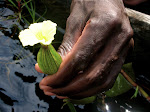
A magical flower

A magical flower
The guide squeezes this flower and it squirts water like a water pistol

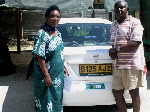
Cathy and Joe Wanzala

Cathy and Joe Wanzala
They couldn't wait to paste the Obama sticker on their car

My main man

My main man
Ernest is my trusty cab driver who blasts music as we make our way through Gabs

Ted Thomas, man of intrigue and style

Ted Thomas, man of intrigue and style
My friend, Ted, and his wife, Mary Ann, hosted a Safari Send-Off for me in Austin and treated me to a special mix of African music that already a UB student and a professor want to download.