Showing posts with label Toyota Surf; Bana Ba Letsatsi. Show all posts

Saturday, September 27, 2008

On the road in the name of art


Maun, Botswana
Sept. 27, 2008
(blogger is letting me down again. lots more art and scenes to come....)

I have always liked the saying, “Life is short; art is long.” This week I had another reason to embrace the adage.


I spent the week at the edge of the Makgadikgadi Pans National Park at Leroo La Tau Lodge. That’s where hundreds of zebra parade to the water hole, and their friends the wildebeests meet them there. I will always remember the distinctive sounds of Leroo: the strange honking, barking noises that zebra make and the beat of their hooves when they are spooked by the least little thing, even a shadow. This week the sounds included the bellows of vociferous lions at close range. I could hardly sleep from the excitement of hearing those roars that can shake a bedridden body right through to the core. One sounded as though it was just outside my room, but I couldn’t find tracks to confirm it.

But back to the art.

I stayed at the lodge to be near Khumaga, a village of 800 people 6 kilometres away. As the DDS volunteer, I went to the Khumaga Primary School Monday through Thursday afternoons to conduct the Khumaga Primary School Art Project. I took a cue from Bana Ba Letsatsi and devised an idea for a DDS community project to raise money for the number one item on the school’s wish list: new traditional dance costumes for their students. Any child who wanted to participate would draw on Monday, and then 30 children would be asked to paint versions of their drawings on fancier paper the rest of the week. We plan to sell the paintings in DDS curio shops, with all proceeds going to buy the costumes. (To see the kind of costumes I’m talking about, look at the Kanye dancers’ photo for my blog entry in July at Lally and Gerald Warren’s 25th wedding anniversary at Lobatse.)

I have this belief that we can learn a lot from children if we stop to listen – and I mean REALLY listen by being totally present. Children the world over, I believe, are innately gifted artists, singers, dancers and storytellers who can prompt us to remember our best selves. Somewhere along the way, especially in the United States, we grow up and find ourselves hammered, nailed and fitted into certain boxes. We close down. We lose our voices, our glorious sense of abandon, our bright-eyed willingness to say yes. We demur if asked to sing (guilty as charged). Mouthing the words becomes our m.o., even when attempting “The Star Spangled Banner.” No, we explain: We can’t draw so much as a stick figure. And, for Pete’s sake, don’t make me step away from this table to dance at the wedding; I’ve got two left feet. (There was a notable though less than inspiring hiatus during the unfortunate Macarena phase and, in Texas, during the call to the floor for the calamitous Chicken Dance. I blame it on the alcohol, and in this case beg anyone wishing to strut around to poultry music, opening and closing your fingers like a chicken’s beak, to take a seat.)

Aside from the Chicken Dance, I say what a pity that so many of us have put away our gifts like tattered teddy bears stuffed into a closet’s dark corner. We used to throw ourselves into the arts with grace and ease, without a whit of self-consciousness. I wonder if we can reclaim that state of being?

My hunch was that the students of Khumaga would delight us with their view of the world, and I was right. They live in an environment that today is largely sand – the color of sand adorns everything. A fine sand blows in great gusts throughout the day. You wipe it from your ears, your sunglasses, the keyboard of your laptop. Nearly all of the villagers’ houses are brown, as is the thatch of the roofs. The few trees to be found are brown and thorny with only a touch of green. A refreshing color is the light blue on the Botswana flag flying high over the kgotla, the gathering place of democracy for the village.

We are approaching the harshest time of the year in this country nicknamed the Thirst Land. The animals move slowly in clouds of dust to the few water holes around. Even the cattle forego grazing for hours to huddle under the shade of acacia trees. The children’s world – what they see every day – is brown save for the blue sky.

What would Khumaga children do with the colored pencils, crayons, magic markers, new brushes and tempera paints that Mpho Ditirelo, a DDS assistant manager, and I brought them?

You’ll see. They painted with abandon. With color. With smiling yellow suns, red flowers and even blue dashes to signal the most precious of blessings in these parts: rain.

In short, the project was a success, at least for this phase. Sixty-two children showed up the first afternoon to do their sketches. My good friend and exceptionally talented painter Frances Hairfield in Morganton, North Carolina, advised me by email not to make it a competition. All children will be doing their best art, she said. If there are “winners,” there will inevitably be disappointed children when there need not be.
And so I told the children, ages 7 through 14, that I knew all of them were artists, and all of their drawings would be shared with managers at the lodge and in Maun. I knew that all of their work would be wonderful. I never said “the best” would be asked to paint; just that some would be asked to paint in groups of 10 in the following days. (Mpho was there the first day to help me in case my Southern-accented English left them confused. She reassured them in Setswana.)

I saw children throughout the week grow in confidence and in pride in their work. On two days the painting sessions occurred under a tree in the courtyard when it was 105 degrees in the shade. The students never complained, even when the wind blew their precious paintings from their desks into the sand. When teachers weren’t around, other children sneaked up from behind and pressed in close to watch the painters work. I had to ask them to back off and give the artists room. That didn’t work. I went to the office to enlist an authority figure, and as soon as Mma Ghanzi appeared in the courtyard, the peanut gallery scattered in a flash, back to their classrooms.

Why were the participants mostly boys? I asked. A teacher told me that girls thought art was boys’ work. How strange, I thought but doubted the conclusion. I could tell as the week progressed that the girls were especially interested in seeing what was going on. I think they were just shy about trying in the first place. The teacher said more of the children every day wished they had joined in, girls included.

At the end of every session, the teachers wanted to see the finished work. They were so pleased. They reported that some children were busy sketching in class during the day in their composition books, to practice.

“They are doing their level best,” one teacher told me.

Which was quite fine indeed, especially for children who had rarely if ever had such brushes, paints and paper. The lack of materials was an obvious issue for the school.

The children didn’t say much to me as we worked together. They were quiet and serious. They wouldn’t so much as pick up a pencil until I said “Start,” which I needed to do until I asked a teacher why they weren’t drawing yet. They shared materials, flattened their hands on each other’s paper if the wind threatened to blow it away. They helped one another with advice in Setswana and sometimes with a careful brush or pen stroke on their neighbor’s paper. The gesture was always appreciated, it seemed. I knew, though, that the project had worked when I heard the children imitating my words. “Very nice. Excellent. Perfect!” They were encouraging each other, just as I had bent over their shoulders and proclaimed those words to them.

As a painter finished a piece, I would hold the art aloft for the children across the courtyard to see. The onlookers smiled broadly, giggled, waved and stamped their feet a bit in approval. The painters themselves stood taller. They loved the acclaim; I could see it on their faces. But most of all they loved making their art. One child did extra drawings and brought them to me as a gift. Another, Percy, did four in one night. There wasn’t time to finish painting them all, but he knew I thought his work was beautiful, and it pleased him.

Why is art long? I could see a spark ignite in these children. As long as the tempera paint lasts, they will be painting, to the delight and wonder of all of Khumaga.

P.S. If any of my friends out there see a painting you’d like, let me know. I can front the $25 (up to a point) on this side of the globe, then I can swap you the painting for the cash when I get back to the U.S.)

Tuesday, August 5, 2008

She don't know jack


Aug. 4, 2008
Maun, Botswana

I started my day with Jungle Judy, the woman who once single-handedly pulled a python out of a trough. She did it herself after the gung-ho bush guys accompanying her on the mission collapsed into motley uh-oh bush guys and scattered like roaches at the flip of a light switch. When that thick python turned out to be longer than Judy was tall and started wrapping itself around her, only then did the chagrined men come back to pull the snake off and tuck it into a sack, away from the chickens it had been menacing, not to mention Judy.

Yes, Judy Phillips of South Africa and now of Maun, age 30-something, is a pint-sized, ballsy sparkplug, and it is thanks to her serving as my broker and intermediary that I now have wheels. She’s the food and beverage manager for Desert and Delta’s lodges. And she took time out this morning to attend to one final detail of my rented Toyota Surf. She insisted I needed a hydraulic jack, because Kobus Lubbe, the owner of the Surf and one of Judy’s best friends, forgot his in the Central Kalahari.

Judy bought a replacement hydraulic jack this morning, and she made Nick the DDS mechanic check whether it was big enough for the truck. With an unlit cigarette hanging out of his mouth, Nick got down on the sand and began coaching me, cigarette still in mouth, on how I would use the jack if I had a breakdown or a punctured tire, or, as they write in Botswana, tyre. I was standing beside him in my skirt and bending down occasionally to appear interested.

If you saw the monstrous size of “tyre” that I would need to wrestle to succeed in changing a tire, you would agree it is hopeless. I told Judy I would revert to my tried-and-true girlie method that consists of standing on the side of the road and looking tearful; usually men stop in a flash, but I guess this is Botswana where it is always possible that the only life form that might pass a stranded motorist is a plodding donkey or a herd of goats.

“Murphy’s law,” Judy said to me. In other words, if I had a jack I would probably never need it, but without one I was as good as a Maun dirt walker again.

The jack she bought me was too small, so off we motored in her Surf to the Motovac, the auto-parts store, possibly the most impressive of all Maun businesses in size and sleekness. You see everyone you know at the Motovac, which gives me the distinct impression that I might be needing that new jack at some stage of the journey.

Turns out that everyone’s vehicle is always breaking down. But this village is lousy with bush mechanics, so even if the vehicles date back to the Stone Age, the mechanics get them rolling again. And lucky for me I live at a safari headquarters where mechanics arrive every morning promptly at 8 a.m. This I count as yet another blessing.

I was waiting in the Motovac parking area when, to my delight, two tiny folk came running for me. Jabu and Fiki! They were waving and wanting to give me a hug. The two little ones go to Bana Ba Letsatsi, the day center for street kids and at-risk children where I have been volunteering lately. Bana Ba Letsatsi means Sunshine Children, and the faces of Jabu and Fiki tell you what the mission is about. (Their mother was nearby; don’t worry that they were hanging out at the auto-store by their lonesome.)

Bana Ba Letsatsi is the little nonprofit that could. It has 226 children on its register. Nowhere near that many show up every day, but children drop in and out – for a hot breakfast or a hot lunch, showers, a place to wash their clothes and a safe environment to read, play sports, do crafts and, yes, watch cartoon videos. You will see photos with this entry that give a glimpse: Jabo/Fiki; Terence, who has a scholarship to the private school where my landlords’ son Kyeren goes and where I attended the barn dance (Terence won a reading award last week!); and Terence again in the office with Matthew Harris, a volunteer from London; Fiona Miller, a Brit who is the center’s executive coordinator; and Oupha, who serves as receptionist and go-to staff member.

I don’t have photos yet of the Botswana classroom coordinators and counselors who work here or of the kitchen staff that makes sure the children receive big helpings of warm food. But they are on hand to do whatever they can for these needy children, many of whom have been skipping school or were sent out into the streets to beg by their parents or, worse, live in homes where abuse is rampant. As far as I can tell, there’s not much happening throughout society to address the abuse, but Bana Ba Letsatsi does what it can to provide the children with a safe place and a daytime refuge. Matthew picks up some children in a combi (a big minivan) at daylight to make sure they go to school and drops them off back home in the late afternoon. An accomplishment can mean providing a tent for a homeless child or moving children away from the bad influences in town to what amounts to a foster grandmother’s house on the outskirts of Maun.

The center receives donations from the European Union and kind-hearted people around the world, most notably a Brooklyn woman who sits on Bana’s board and sends money from her foundation. Tourists mail checks. Others drop by occasionally and dump contents of their extra suitcases. Last week, books, eyeglasses, clothes, children’s Tylenol, pads of paper, colored pencils, Band-Aids and, oddly, Pine Sol in plastic bags lay in a heap on the floor waiting to be sorted. Someone had stopped in between flights and left a much-appreciated bounty. The center has a 60-year-old Peace Corps volunteer from Alaska attending to finances. Local businesses, a few of them anyway, including Desert and Delta, have lent support, and a big hope at Bana is that more local businesses will embrace the center in the coming years.

I have always loved children, and during this sabbatical year I am meant to be in their company. I’m not out to change the world here. I do simple things, but the interactions with the children go a long way toward feeding a tired soul accustomed to running on newspaper deadlines instead of playgrounds and sitting at computers instead of see-saws. Each one of the little ones deserves my thanks. I push Fiki on the swing. I help Rose practice her reading. I listen to Terence read his books for his homework.
During the school holidays a few weeks ago, I played ball with the children at the sports complex and on another day I went with them on a hike at the nature reserve. Like any good safari-goers, we hoped to see the zebra or giraffe at the reserve (no predators at this park), but, like many good safari-goers, we had to settle for a couple of impala. On another day, my task was to separate all of the medicines in an office cabinet and organize them so that little kids wouldn’t run the risk of being given a dose of over-the-counter drugs meant for teenagers and adults. And on yet another day I helped Fiona write a letter asking for support to make a dream come true: The woman in Brooklyn has invited Bana children to New York in April 2009 to see the educational and cultural sights and to be on hand for a fundraiser for Bana. Fiona hopes that 10 children might be able to go, with 2 staff members accompanying them.

But New York is across the globe; despite free accommodations the expense would be staggering. And yet, even in faraway Maun, dreams for those with tangibly little cause for hope are big and stoked by the smallest of gestures. Just look at the smiles. You’ll see resilience enough to humble any world-weary visitor.

And, as for the bush mechanics: When I mentioned to my landlords last week that Bana’s Land Rover Defender had broken down yet again and Fiona was heartsick and confused about whether to spend 15,000 Pula to have it fixed or whether instead to chuck it, my landlord Stuart said, no way, his mechanics would have a go at fixing it, probably for free or at least for a lot less than a local garage was charging.

Today he had the Defender towed to this property. The Karibu Safari mechanics arriving outside my door at 8 a.m. tomorrow might not know it yet, but they have a noble job waiting for them, one that will help ‘the little center that could’ keep rolling. And that is fine news indeed for Jabu, Fiki and the rest of the Sunshine Children.

P.S. Want to see how high I can swing?

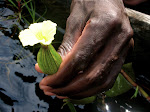
A magical flower

A magical flower
The guide squeezes this flower and it squirts water like a water pistol

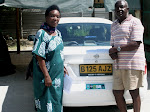
Cathy and Joe Wanzala

Cathy and Joe Wanzala
They couldn't wait to paste the Obama sticker on their car

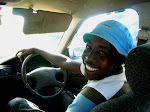
My main man

My main man
Ernest is my trusty cab driver who blasts music as we make our way through Gabs

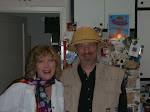
Ted Thomas, man of intrigue and style

Ted Thomas, man of intrigue and style
My friend, Ted, and his wife, Mary Ann, hosted a Safari Send-Off for me in Austin and treated me to a special mix of African music that already a UB student and a professor want to download.