Showing posts with label Etsha 6. Show all posts

Tuesday, October 7, 2008

Beauty, Form, Function


Xugana Island Lodge
Okavango Delta
October 6, 2008

My road trip to the Tsodilo Hills and Etsha 6 last week had been a goal of mine for months. I must thank Kitso, a former Xugana guide, for helping make the trip happen. When I was volunteering at Xugana Island Lodge in June, I heard that his sister in Etsha 6 made beautiful baskets. I promptly began peppering Kitso with questions about his village’s reputation as a basket-making center, acclaimed as the best in Botswana. I made a pushy and no doubt culturally impolite request that he introduce me to his sister someday; I wanted to see her at work and talk with her. He graciously agreed, and so last week we went to Etsha 6 for Kitso to begin his 11-day time-off from Camp Moremi and for me to meet his sister.

You’ll see in my photos Ipolokeng Montsheki, whose first name means “beauty.” I was told I was welcome to call her that. I visited her first at Kitso’s house, where she was sitting under a big shade tree that sheltered the laundry buckets used for all the compound’s washing. It was clear that Kitso would have to translate any conversation I had with Ipolokeng. Not many white people stay overnight in Etsha 6, and, throughout the village, an American accent throws Setswana-speaking people into confusion easily. Beauty and I quietly sat next to each other for a while. I wanted to keep my interruption of laundry time to a minimum.

I went to visit Ipolokeng again at the Rush Inn, a butchery stacked with dripping chunks of red meat. That’s where she works. Between serving customers she sits outside to make baskets.

Through Kitso’s translation Ipolokeng told me it’s not easy to find the fan palms she uses for the fiber for basket making. She has to walk far to find them. Kitso said about 60 percent of the women do basketry in Etsha 6 to earn money for their households; everyone is looking for the same plants. After collecting the leaves Ipolokeng boils them in water, then dips them in cold water. This process renders a natural color for the baskets. If she wants dark colors for her original patterns and designs, she relies on different kinds of tree bark to achieve the colors she wants. She pounds the tree bark into powder to put into the water. Bird plum and magic guarri (Kitso wasn’t sure of the spelling) are two types of trees whose bark comes in handy for color variation.

Ipolokeng’s mother taught her the art of basketry. The tools are simple: an awl and a bowl of water for dipping the leaves and one’s fingers to ensure pliability of the fibers. The process, however, is anything but easy. The coiled baskets take a long time – up to two weeks for a small platter, up to two months for a basket Ipolokeng made that was half a meter high. A fine basket has a tight center, a weave that is not rough and no strings askew in the pattern, she said.

I loved her baskets. She had only a few, all of which were promised to someone who had made a special order. I didn’t want to give up and leave famed Etsha 6 without a basket. Anyone who knows me knows that I am an art lover. How could I leave Botswana without taking home a treasure by one of the artists with whom I was now acquainted? I tried my luck. Would Ipolokeng consider selling me the covered basket at a premium and then make another one for the client? I am most grateful that she agreed. You’ll see a photo of her holding my basket in her lap.

Despite my unfortunate encounter with bedbugs at the Etsha 6 accommodation, I remain glad that I made the trek to the village on the western side of the Okavango Delta to learn about basketry and to meet one of Botswana’s artists. In a world I inhabit that is too often filled with artifice, I found in Etsha 6 something different: authenticity -- Beauty, form and function -- a worthwhile road trip indeed.

P.S. Below are book excerpts that describe the area and its artistry.

From “African Basketry: Grassroots Art From Southern Africa” by Anthony B. Cummings and M. Elizabeth Terry:

“In many parts of the world, indigenous and minority peoples occupy remote areas. This remoteness has been a major factor in maintaining habitats and societies intact. It has also been a factor in the retention of basketry skills. It is no coincidence that the most beautiful baskets are products of dusty, dry, drought-prone landscapes. Basket-making is hard work and the finest basket-making skills often belong to the poorest households….

In the early 1960s Etsha teemed with wildlife. By the early 1980s, there were millet fields devoid of trees, yet getting there from the district centre of Maun still took eight hours of grinding along in four-wheel drive. There was no electricity or telephones, and the best way to get a ‘quick’ message was by telegram sent by hand from Maun. The past 20 years brought remarkable change. In 1986, the first computer run by a generator appeared in the nearby village of Gomare. By 1992, a tar road linked Etsha to Maun, reducing the trip to a comfortable three hours. Five years later, Etsha had a microwave tower for communication by cell phone and computers linked to the Internet, where Etsha schoolchildren could view international websites selling baskets from their village, complete with photographs of basket makers they knew.

Despite these dramatic changes, there is still continuity with the past in Etsha and many villages across southern Africa. The sound of women pounding millet in mortars with pestles still resounds past thatched homes and across open fields. Women still walk home barefoot in the setting sun with baskets on their heads full of household possessions.

“Many people have the idea that a basket is something that can be made in just a few hours and requires little skill. In fact, basket making is a difficult and time-consuming business. When one considers the actual weaving time, let alone the time needed to collect and prepare the raw materials, the number of hours is staggering.

Weaving time varies according to the type of weave and, in the case of coil-built baskets, the size of the coils, the size and spacing of each stitch, and the type of material used for wrapping. For example, an average (30 centimeters diameter by 7 centimetres high) coiled bowl-shaped basket made from palm fibre with medium-size coils and close stitches will take, on average, 25 hours to complete. For some basket makers, however, as may as 40 and even up to 80 hours may be needed. A further 16 hours must be added to include the time taken to collect the palm fibre and dye materials; to collect the water and firewood needed to prepare the palm; to sort, process and dye the palm or roots; and to travel to the nearest craft buying centre to sell the basket….

Even those weavers who weave quite steadily cannot do so for much longer than five to six hours every day. This is due to the sore neck, eye-straining and backbreaking nature of basket making, apart from other commitments around the household such as carrying water, gathering firewood, food preparation and childcare. This means that an average sized, bowl-shaped, coiled basket can take from two weeks to one month to produce.”

Saturday, October 4, 2008

Tsodilo Hills Redux


Maun, Botswana
Oct. 4, 2008

This camping trip could not have been more different from the one last weekend. This time Tsodilo Hills was calm, peaceful, inviting at every turn save the extreme heat of the day. My guide friend Kitso from Desert and Delta Safaris accompanied me on this trip to introduce me to his sister, an Etsha 6 basket maker I wanted to interview. I was giving Kitso a lift to his home village for his 11-day time off from the DDS lodges.

Kitso had never been to the hills and on the way he told me stories of the San people, commonly known as the bushmen of the Kalahari. It was news to me that Kitso's grandfather on his mother's side was a San traditional doctor, someone who used herbs to heal people and "threw bones" to talk with the spirit ancestors about someone's health or life situation. He worked in a house in front of the medical clinic in Gumare, Kitso said, so that patients, in two stops, could have treatment that combined traditional healing with Western-style medicine. He recalled how his grandfather would take him on trips into the Delta; they would sleep under the night sky, in the open, beside the fire and listen to the sounds of the animals.

On this trip, I made it to the far side of Female Hill to the most sacred site for the San people. It is a distant cave where an eternal spring bubbles up. Kitso braved swarming wasps and moths to go in, down to the water, to wash his face and hands and fill his 1.5-liter bottle. I have had a strong aversion to wasps since I was a child. They stopped me from going into the cave, but that was not the only thing: It didn't feel like a place I should enter. I can't explain it exactly. My inclination was just stand still on a rock outside and look out over the Kalahari Desert. That's what I did. When Kitso climbed out of the cave, he shared some water with me, enough to splash over my sweaty face and neck. It was an important trip for him, retracing the steps of his grandfather and his father, and I was most appreciative of the chance to hear his stories. I felt I had made a journey into a psychological and cultural realm of Botswana seldom experienced by tourists. And once again my passion for African skies was rewarded. You can see the glory of the sunset.

Where NOT to stay


I had a wonderful road trip back to the Tsodilo Hills and to Etsha 6, the center of the highest quality baskets in Botswana. But I reached a new low in accommodations at Etsha 6. A teacher who volunteers at Bana Ba Letsatsi assured me that he stayed at this guest house frequently and that it would be fine for me.

Au contraire.

I could not resist sharing this with you to show that I am willing to swallow hard and give someplaces a chance. This was the only accommodation in the village. I needed to give it a chance. I tucked myself on top of my sleeping bag atop the bed, placed my bug hut over my head and tried to fall asleep to the sound of the loudest donkey braying you have ever heard. Soon I could feel something biting my face and my neck. ARGH. Bed bugs!!!!

I promptly moved myself, a flashlight, water, my sleeping bag and pillow into the backseat of my car. That's where I spent the next 8 hours trying to sleep. There were times when my mind drifted back -- I couldn't stop myself! -- to some of my favorite hotels: The Peninsula in NYC, Mission Inn in Sonoma, Miraval in Arizona, the Intercontinental in Beijing, the Four Seasons in Austin, The Homestead in Virginia....Why was I punishing myself? I think I believed if I could imagine those buttery linens at The Peninsula, I could recreate the feeling with my back to the car upholstery. It didn't quite work like that.

You might wonder why I didn't drive back to Maun, burning rubber all the way. I had been warned: DO NOT DRIVE AT NIGHT!!! Even in the day, I saw impala, ostriches, cattle, donkeys and goats, some of which stood right in the middle of the road, some of which were so stubborn I could only swerve to miss them. Too many people crash into too many animals on that stretch of road. And there's only one fuel stop between Etsha 6 and Maun. So I was stuck in the Toyota Surf with my windows cracked and my friend Kirk's giant Maglite torch at the ready in case I needed to bash somebody's head. After I got used to the yoga positions for sleeping, I managed to sleep fairly well and had the happy (seriously) pleasure of waking to the sound of more roosters than you'd find at the state fair. Nice sunrise. Nice time. But oh how I hate bed bugs.

Tuesday, September 30, 2008

Lifting up my eyes at Tsodilo Hills, for a price


Maun, Botswana
Sept. 29, 2008

With only a couple of music CDs with me on this journey, I have incessantly played an old one I have by NRBQ – remember that bluesy, piano-pounding Kentucky group, anyone?

It is a great 4WD companion for singalongs in my rented Toyota Surf on sandy roads, but it is the source of many an earworm. An earworm is a song you cannot get out of your head. Like a gnarled tape it reverses and plays over and over again. It can be a terrible song (“Do you like pina coladas,” for example, or “Honey” by Bobby Goldsboro come to mind. Sorry, pal, if I gave you an earworm just now.) But it can be a fabulous song, usually a single line or two that gets stuck in the brain. NRBQ’s ditties belong to the latter category.

NRBQ has infected me with several earworms lately, and one is, “There ain’t no free. There ain’t no free…It might be credit. It might be barter. But they’ll always find a way to make you Pay! Pay! Pay!”

And that brings me to my latest excursion.

When I came back from Leroo La Tau on Friday, I got word of a dandy offer. I could hop on a bush plane on Saturday afternoon, fly to Shakawe, meet a guide with a game truck crew who would take me to the Tsodilo Hills in the Northwest Kalahari for an overnight camping trip and drive me back to Maun on Sunday. A Norwegian civil engineer on assignment to Botswana’s roads department in Gaborone had booked the trip and paid for it; there was room for me to come along for free. (cue to sing along with NRBQ....”There ain’t no free.”)

I had been hoping to go to the Tsodilo Hills around Oct. 1 on a trip with a guide friend to meet his sister, a basket weaver in Etsha 6 on the western edge of the Okavango Delta. But on Friday, I had felt a distinct call in my morning quiet time to go to the hills and sleep under the stars at Female Hill (if it sounds woo-woo, too bad; it’s the truth.) And voila. Here comes the offer for a free trip a few hours later. I think I’ll answer the call, I thought to myself, and say yes right away.

The Tsodilo Hills are Botswana’s lone World Heritage Site. They are sacred to the San people, and even today people make pilgrimages to the hills to wash in the spring water, which is considered holy. Rising 400 meters above the bush scrubland, the rock outcroppings inspire awe and any flatlander’s desire to explore. On these hills are about 2,000 rock paintings dating back 3,000 years – orange-colored renderings of kudu, rhino, giraffes, zebra, dancing people, geometric shapes. It is said that the spirit of every animal and insect is here. The San believe that powerful gods live in the caves of Female Hill from which they rule the world and can cause harm and misfortune to offenders.

I must sadly report that my group of 5 apparently contained an offender. Could be me, for all I know. Here are the facts:

John, a 62-year-old Norwegian family man, and I were dropped off at the quaint, thatched airport gazebo in Shakawe by the two pilots of a four-seater plane. No one was there to greet us. I found an official Botswana military cap sitting on a shelf and a torn canvas tennis hat on a counter, the only signs humans had been there lately. The pilots were concerned. Would we be ok? Sure, I’ve got the booking-agency representative’s emergency phone number. The pilots flew away. John and I stood and waited. No one ever answered the emergency number. I enlisted help from my friends at Desert & Delta, who went to work trying to assist me. John had no water, and I had a few sips left in my bottle. I wondered how far we might need to walk. I wondered how long my cell phone battery would last.

Forty-five minutes later the game truck arrived. Such tardiness is way out of line in the protocol of meeting guests in Africa. Tourists drop down out of the sky often into grass airstrips in the middle of nowhere; someone must always be there to greet them, offer water and move them safely into vehicles, away from elephants and predators. While we didn’t have to worry about wild animals at the tarred airstrip in Shakawe, we did have legitimate concerns about where the heck we were and where the heck we might need to be before dark.

The guide Thabo was most apologetic, and I figure it was not his fault that the expedition arrived late. The culprit appeared to be Kilos, the cook in the crew. He was off his rocker drunk as a skunk. The other crew member was Linda, sober and efficient.

We were late, and we needed to be at the campsite before dark. My heart sank when I realized the guide was counting on Kilos to direct him to the proper turns and bush tracks. Ai yi yi. What a predicament. Directing meant that Kilos would occasionally flap his right hand in some direction before he would fall back into his seat. We were speeding in that Land Rover – up to 80 kph, which is teeth-rattling fast. You can only duck your head to keep the wind and sand out of your eyes. Forget seeing the scenery, not that there was much variation in the desert surrounding the hills. We did stop quickly once to get out where the sign said “Tsodilo view;” because of smoke from bush fires I couldn’t see anything. I chose the occasion to say to Thabo that the cook was drunk off his butt.

“I’m trying to make sure you don’t notice. He’ll lose his job,” he told me.

Sounds about right for a penalty. How could John and I not notice, especially when the crew stopped to collect firewood and Kilos contented himself with trying to pick up and drag a log big enough to span a river? Needless to say, he failed. And how could we not notice when he stepped from the truck, turned his back to us a few feet away and peed in the grass? Or when he sat with his finger up his nose for quite a while. I felt my appetite dwindling.

We stopped for John to take a photo of the sun slipping behind Male Hill. (The Tsodilo Hills include Male Hill, Female Hill, Child Hill.) How we powered through the bush at top speed past thorn branches without serious injury I don’t know. But we made it in one piece. We worked together hurriedly to set up camp at dusk and in the dark. Kilos fumbled but managed to cook something for us and not burn down the park. Thabo ate with John and me. At one point John’s comment about a young woman he had met eating like a horse tickled Thabo, which prompted Thabo to spit out his red wine, all over me. At another point he said out of the blue how he was feeling bad because he had been “cross and aggressive” with his girlfriend the night before. When we had made a quick stop before the park’s entrance at a local village, Thabo had gone to see the head man to request a guide for the paintings tour the following morning and, unbeknownst to us at the time, to ask what he could do to make up for being “cross” with his girlfriend. He was mulling the situation over dinner, which, I guess, is why he brought it up.

I can only conclude that Thabo had an appointment with the avenging forces at Female Hill; poor John and I were the lucky bystanders. (“There ain’t no free….”)

During the night a dog barked warnings. I woke up to hear a man yelling in Setswana. A few English words were thrown in: “I’m going to KILL you! I’m going to DESTROY you!” It was Thabo. Somewhere out there in the dark, he was instructing us “to be very careful!!” Young men from the village were around, Thabo yelled. They wanted to invade our camp. They wanted to steal our food. I moved into a fetal position in my sleeping bag after hiding my wallet and camera under my pillow. How exactly should I “be careful?” That was about 1:30 a.m. At about 2:30 a.m. I heard what I imagine were lids being screwed on and pans rattling. I figured this was going to be a long night. I was right. The next thing that happened: a raging windstorm was upon us. Gusts of fine sand blew into my tent, covering everything in it and making me feel at times I was being buried alive. It’s a mystery how I got sand in my belly button, but I did while the fierce winds blew. The winds were still churning when we arose for breakfast; even the milk blew off the cereal in the bowl. You’d think we were on a ship tossed and turned by waves.

The sooner we could start the hike, the better. Female Hill, imposing and gleaming yellow in the early sunlight, awaited us. With local guide KT, Thabo and Linda, we started our climb. Those paintings were wonderful; they naturally set one’s imagination rolling back to the time when Botswana’s earliest tribes lived in the caves. And for me there was a definite vibe around the place, a certain energy I can’t define. Last year I read about Sir Laurens van der Post’s first experience of the hills. My Bradt guide gives you the nutshell version: In ‘The Lost World of the Kalahari,’ you can read the story of his first visit, “of how his party ignored the advice of their guide, and disturbed the spirits of the hills by hunting warthog and steenbok on their way. Once at the hills, his companion’s camera magazines inexplicably kept jamming, his tape recorders stopped working, and bees repeatedly attacked his group – and problems only ceased when they made a written apology to the spirits.”

The Tsodilo Hills museum displays an excerpt from van der Post about this phenomenon.


Early on our hike Thabo explained to me that he thought it was very possible Female Hill was working its magic on him. He went into full confession mode about how he had hit his girlfriend and how the police might be waiting for him in Maun with an arrest warrant. Would I consider going with him to see his girlfriend to “mold her opinion” of him. I couldn’t believe this. To relieve his conscience, he unknowingly picked as a confidant an American who has devoted part of her newspaper career to writing about the ravages of domestic violence. It was all very strange. Our conversation went like this:

Did your father hit your mother? I asked.

No. He hit me. He thought it was good discipline.

Would you ever hit a stranger on the street or one of your guests?

No, never, never.

Then why would you hit someone in your home, someone you say you love?

I don’t know. Alcohol, maybe? No, I don’t think that’s really it.

I don’t think so either. In the United States I have found that this happens when a man wants power or control over a woman. Could this be you?

Maybe. When you’re in the bush a long time, thoughts of jealousy come; maybe your woman is with another man. I don’t know what will happen. I want forgiveness.

I told him I would not go with him and make peace with his girlfriend. “In the U.S. we have a saying that if you make a mess, you clean it up,” I told him. It’s never ok to hit someone you love.

Thabo was quiet after that. When we got to the cave where the legends say the powerful serpent spirits live, he did not remain outside as he has done on his previous three visits. He went in, a trip that was part of the penance the village head man had instructed him to do. I stayed outside (I don’t like closed spaces), sat on a rock and closed my eyes to behold glorious colors in meditation. John was pleased with his trip into the cave. Thabo felt better.

We returned to the campsite, ate more of Kilos’ cuisine, which I don’t recommend, and broke camp. On the 5 _ drive back, John wisely sat in the passenger’s seat in the cab of the truck with Thabo. I sat in the game drive seats, my ears bursting with the noise of the wind, my eyes swelling from the grit and wind. I don’t think I’ve been that dirty since I made the four-day trek to Machu Picchu. My shower at home in Maun felt like a visit to a dream spa.

And my trip to Female Hill feels like a dream that unfolded in violent gusts under starlight. The company that led my excursion and to which I paid with cash tips and unexpected guidance counseling? AfrikaCalls. Considering my reveries last Friday, interesting name, that one. But my advice is hang up. There ain’t no free.

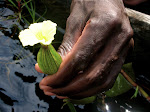
A magical flower

A magical flower
The guide squeezes this flower and it squirts water like a water pistol

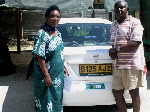
Cathy and Joe Wanzala

Cathy and Joe Wanzala
They couldn't wait to paste the Obama sticker on their car

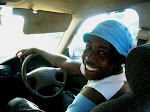
My main man

My main man
Ernest is my trusty cab driver who blasts music as we make our way through Gabs

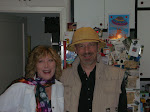
Ted Thomas, man of intrigue and style

Ted Thomas, man of intrigue and style
My friend, Ted, and his wife, Mary Ann, hosted a Safari Send-Off for me in Austin and treated me to a special mix of African music that already a UB student and a professor want to download.