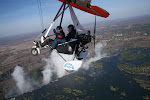
A week ago I planned to write about one of the most intriguing guests I met during my time at the DDS lodges. On the day there would be an attack at the property where I live in Maun, out in Savute Paul Berg was telling me jokes --he spent two years as a stand-up comic -- and piquing my interest in his profession as a forensics psychologist. The trials for the Unabomber, the Oklahoma City defendants, Rodney King after the riots in Los Angeles: he told me was involved in those cases.
Do you remember the line uttered by Rodney King in 1992, Paul asked: "Can we all get along?"
I told him I did, absolutely; I regarded it as a defining line of the '90s. It was the statement that brought race relations into stark relief in the aftermath of the LA police officers' beating a suspect senseless. A passerby captured the brutality on videotape which aired on national television and enraged a city.
"I wrote that," he said of King's famous plea.
It strikes me as cruel irony that I was focused on thinking about the Rodney King trial and in particular his iconic statement on the day intruders beat and stabbed my landlords. I wish someone in this village would speak such a line, ghost-written or not, and mean it.
Monday, July 28, 2008

Sunday, July 27, 2008
Africa, bright and dark

July 27, 2008
This photo I took at Xugana Island Lodge was supposed to commemorate Bruce, the raucous-sounding resident hippo, who made the rounds after the staff and guests went to bed every night. He sloshed out of the lagoon and wandered around chewing grass. I spent part of one full-moon night listening in awe as he chewed the grass on the other side of the wall from my bed, and then I listened some more as he trudged along the perimeter, his big feet making what can only be called a soft, spongy sound. I looked out my window and could see his shadowy figure in the moonlight.
Bruce often left a calling card. His tail whipped like the blades of a fan, spraying dung on plants, path lights and the markers for the path. It signaled to anyone interested that this was his territory, where he had completed his work for the evening. One day I spotted his calling card on what I thought was an orchid. My friend Julie Ardery, who founded www.humanflowerproject.com in Austin, took a look at my flower photo and sent it on to an expert. In a jiff the word came back from Julie that this was a shell ginger on the palm leaf. Shell gingers are found in Asia; Julie dubbed this a new example of globalization.
I thought the photo would be appropriate given the events of the past week. There is the beauty of the blossom. There is the coating of dung. The polarity of light and dark, the painterly fragility of a flower and the smelly spray of crap. Life hands us all of that. What do we do with it?
Acceptance. That's the only word that comes to mind for me today. Acceptance of it all.
Saturday, July 26, 2008
A bend in the river
July 26, 2008
Maun, Botswana
Before I came to Botswana I heard the rumors and fielded the questions: She’s moving to Africa?! She must have fallen in love with a man while on vacation. Why else would she pack up and leave everything – her normal life-- for a year? It HAS to be a man.
It’s true that I fell helplessly head over heels in the way I have done in the past for a man, but this time the heartthrob that left me breathless was a country. When I was standing out in the wilderness marveling at the sunset last July, my heart felt truly at home and as full as at any time I was falling off the familiar cliff for a man. Maybe fuller.
My many blog entries confirm how I came here to Botswana wearing sparkling, rose-colored glasses. I was crazy in love with a place. I also knew, much as I hated to entertain the thought, to prepare myself, for my idealized view would not turn out to be the whole picture and my affection would most likely be tested in some way.
This was the week.
I am writing about this because I find writing helps me to sort out my feelings and think through knotty problems. As one of my writer friends says, I’m not sure what I think of something until I write my way through it.
My last blog entry talked about how I was rushing off to the bush again, this time to fill in for an assistant lodge manager needing to return to his village for his sister’s funeral. I was sad that there was yet another young person’s funeral in Botswana (the numbers are astounding) but selfishly grateful to receive the request for my return to Savute Marsh, just outside Chobe National Park. I could see the elephants again and hear the lions and, with any luck, see my first cheetah in the wild.
The remote bush is magic. Sit and look in one direction for a few minutes. You will be amazed at the show changing before your eyes: Elephants silently come out of nowhere to drink water. A martial eagle flies in. A family of warthogs trots by. Over there, in the thorn-bush, the leader of a group of impala peeks through to see if the coast is clear to the water hole. A little elephant shows up, a deformed misfit -- he has a conical stump where his trunk should be -- but he manages, with his right back leg stretched straight out behind him, to tip himself forward, as if in elephant yoga pose, and with unspeakable grace he sips from the water hole. Later the wild dogs might circle. I will never tire of the view.
The plan was for me to fly in on July 15 and stay until Sunday or Monday. That would have me back in time to work on solving my transportation challenge and to prepare for my volunteer work set to begin on July 23 at Bana Ba Letsatsi, a Maun nonprofit that cares for at-risk children.
As it happened I was in the dark about my departure time. Our radio communications went out at the lodge, and I wasn’t getting any information about when I might leave. By Monday I was worried about when I would ever be back in Maun. Word finally came that afternoon that I would fly out on Tuesday.
And so this week, on Tuesday, I flew back to Maun, where I was met at the airport by Desert and Delta’s head of HR, Adrienne, who has gone out of her way to welcome me and help at every turn of my journey to Botswana. She lugs my bags. She gives me “mystery guest” assignments. She checks in with me by SMS to let me know she and her husband are there if I need anything.
This time she met me with bad news: On Monday night there was an intrusion on the property where I live and it was terrible. She offered to put me up in town for the night. But I said no. I wanted to go there and find out for myself.
The taxi ride on the sandy road to my house was interminable. Would my place be ransacked? Would my laptop be gone? How bad was it? I was supposed to have been sleeping there Monday night if not for the delay in my departure. What might I have faced alone in that cottage?
The local Maun newspaper, which got many of the facts wrong in the news story, got some of them right in its editorial yesterday, “The incident this week which resulted in a resident and his wife being stabbed when assaulted in their home has sent shockwaves through the community….”
I found my little cottage untouched by the violence. But next door, a few yards away in our fenced compound, I found Stuart with his face and eyes swollen and gauze wrapped around his head. His wife, Kim, had bruises on her head and a small but fat bandage on her back, behind her arm. Their 10-year-old son, my buddy who gives me survival tips for the bush, was physically unharmed but exhausted.
This is how the attack was described to me, in hurried and piecemeal terms, and I write this admittedly without my having had the courage I have in my professional life to go back and double-check every last detail before publishing. I am too heartbroken for my neighbors’ plight to ask again:
Kirk, an architect and one of the owners of the safari company who lives in an apartment in our compound, had been sitting in the living room of my and his landlords’ house, the green, thatched-roof house that I have described as having a storybook quality. He left just after 9 p.m. to go to the River Lodge for a drink.
Not 15 minutes later two men barreled through the door of the green house. Stuart was sitting on the couch doing work on his laptop. One of the assailants attacked him with a metal bar, likely a crowbar. He was knocked out, and he crashed through the glass coffee table. Blood was everywhere. They went after Kim and knocked her down. They left for a minute or two and returned. The smaller one zeroed in on Kim, now in the bedroom. He pushed at the bedroom door, trying to get to her and the boy. Kim struggled to push the door closed. They went back and forth like this until the man managed to squeeze his arm through the opening and began stabbing her.
The little boy was yelling at him to get out. But the knife worked. The attacker pushed his way into the bedroom and beat Kim some more when she lay crumpled on the ground. The little boy was brilliant, clever beyond words. He managed to slip past and out the bedroom door. He grabbed the 911 radio from the floor where it had fallen and rushed into the dark. He hid in the darkest spot he could find on the property and radioed for help. All over Maun this week people have been talking about the chilling call from the child, and I cried when I heard him tell me what he had done. How brave he was.
The 911-radio system is bush-style vigilance in a town that hasn’t yet earned the designation of being called a town by the Botswana government. Maun is still considered a village, a frontier-like settlement growing fast, where crime is on the increase and the police haven’t been able to cope. Most tourists never even see Maun. They fly into the airport on Air Botswana from Johannesburg and out by bush plane a few minutes later into the pristine world of the Okavango Delta or the savanna of Chobe National Park.
In Maun the citizens have stepped into the law enforcement void with a take-no-prisoners attitude. One woman who has seen the 911 response in action described it to me as a scene out of the movie “Mad Max.” As soon as a call comes in, residents from every corner of Maun in the network respond. They roar to the scene in their 4X4s and aboard ATVs, some with guns slung over their backs, some with sticks in hand and with their spotlights scanning for the intruders.
At the property where I live it’s estimated that they began arriving within about 3 minutes of the little boy’s call. The quick response has been a true comfort to those who live on this property.
You pay for a radio and an annual membership in the network, and in return you are expected to respond in whatever capacity you can to emergency calls. The head of the network is Sharif (I’m not sure of the spelling). He is a Muslim family man, a local businessman and a renowned tracker of criminals. The only thing that stops his pursuit is prayer time, when he unfolds his rug, falls to his knees and prays to Allah. He showed up at this property and tracked through the night. So did the police. They followed the criminals’ footprints in the sand in the way guides track the lions.
By 8 a.m. Tuesday, the police had caught the suspects, who I am told have confessed and have led police to the stolen money and items taken from the green house. The police performed so admirably that Stuart has written the head of law enforcement for all of Botswana to commend them.
Standing inside the green house as Kim was telling me the story, I looked at her and couldn’t stop my tears when I imagined what her family had been through. And I told her how before I left for the bush I had seen a man walking near our fence line. It was daytime. I was standing in my cottage, its sliding glass door open, and I was sweeping the dust and pellets from the so-called “tree squirrels” from my place. The man stared in at me. He gave me the creeps. He wasn’t like men in Botswana. There had been no greeting of hello and a wave. I had a bad feeling. I watched him as he walked and he kept turning back to look behind him. I remember thinking I need to remember this guy should anything bad happen. Later that day I asked Kirk whether I should be concerned about what I had seen. He said no, a lot of neighbors walk by the fence to go down to the river to fish. That guy was probably one of the neighbors, he said. I wasn’t so sure.
On Tuesday afternoon, Kim looked surprised when I told her the story.
“Can you describe him?”
I said I couldn’t really describe his face, but he had been wearing a striped shirt. Her eyes widened. Striped, how?
I told her horizontal. Blue and White.
“Dark or light?”
I wanted to say dark. I knew it wasn’t baby blue. I knew it was a rugby-style shirt.
A few minutes later, Kim had me peek out the window, from behind the curtain. The police were putting the suspects in the truck after having made them retrace their steps to find the goods. I couldn’t see the bigger one, the one called the more “vicious” of the two. But the “weaker” one, the one who had stabbed Kim, was wearing the rugby shirt I had described. The guy must have been casing the property the day I saw him walk the fence line.
As I write on this Saturday morning, men are outside hammering. Stuart has ordered a replacement fence to be built, a taller one far different from the chain-link model currently in place. Our bush view will soon be gone. New bolts are on my doors. We have security at night making the rounds. Beside my bed is a can of “Gettem,” a ridiculous-sounding name for Mace. I sleep with my cellphone under the pillow beside me with the number on the screen for one of the men I know who will respond in an emergency. For several nights it was the number for Bernie, Adrienne’s husband. Last night it was Kirk’s. A businesswoman in town called to check on me and said I must buy a 911 radio (or she would buy it for me), but I opted not to after Adrienne said it would frighten me more to hear it; a cellphone was fine. I opted as well not to buy the “taser” stick the woman recommended.
The newspaper editorial yesterday closed with, “The police in Maun cannot be blamed for an inability to stop crime in its entirety. The force is understaffed and there are not enough vehicles. Patrols mounted by the police and special constables, and on occasion by the security forces, are mounted day and night but the deviousness of the criminal element must be recognized. The community is urged to take all reasonable precautions for protection purposes.”
Which is a little like an editorial extolling to students the benefits of completing their homework.
What does one do when a love affair takes a turn?
I am watching. I am listening. I am sleeping, sometimes with one eye open. I recall how I lived for 3 months in the bush with my laptop and digital camera in full view and my wallet with its passport in my backpack on the floor. The lodge managers have no safes in their rooms and in most cases no locks on their doors. Except for the first day, I never worried for a moment about my safety or my belongings’ safety in my tent or house. Even with wild animals pacing at night, the remote bush, it seems to me now, is far safer than civilization.
In the outskirts of Maun where I live, the doves made their morning calls as usual today. The winter sky dawned its constant blue. My big plan for the day is a trip into Maun to buy groceries so I can cook spaghetti tonight for all of us who live on the property.
I am convinced that Africa has more to teach me, not just about light so bright one must don rose-colored glasses to withstand the splendor but about the shadow side of life that all of us would prefer to ignore, no matter where we live. For now I am staying. But I am not as giddily happy or as carefree as I was a week ago. And it brings to mind a common expression among Africans I have met, black and white; their quiet response to anything that demands sympathy or a signal of human connection in times of trouble: “Shame. Ah, shame.”
Maun, Botswana
Before I came to Botswana I heard the rumors and fielded the questions: She’s moving to Africa?! She must have fallen in love with a man while on vacation. Why else would she pack up and leave everything – her normal life-- for a year? It HAS to be a man.
It’s true that I fell helplessly head over heels in the way I have done in the past for a man, but this time the heartthrob that left me breathless was a country. When I was standing out in the wilderness marveling at the sunset last July, my heart felt truly at home and as full as at any time I was falling off the familiar cliff for a man. Maybe fuller.
My many blog entries confirm how I came here to Botswana wearing sparkling, rose-colored glasses. I was crazy in love with a place. I also knew, much as I hated to entertain the thought, to prepare myself, for my idealized view would not turn out to be the whole picture and my affection would most likely be tested in some way.
This was the week.
I am writing about this because I find writing helps me to sort out my feelings and think through knotty problems. As one of my writer friends says, I’m not sure what I think of something until I write my way through it.
My last blog entry talked about how I was rushing off to the bush again, this time to fill in for an assistant lodge manager needing to return to his village for his sister’s funeral. I was sad that there was yet another young person’s funeral in Botswana (the numbers are astounding) but selfishly grateful to receive the request for my return to Savute Marsh, just outside Chobe National Park. I could see the elephants again and hear the lions and, with any luck, see my first cheetah in the wild.
The remote bush is magic. Sit and look in one direction for a few minutes. You will be amazed at the show changing before your eyes: Elephants silently come out of nowhere to drink water. A martial eagle flies in. A family of warthogs trots by. Over there, in the thorn-bush, the leader of a group of impala peeks through to see if the coast is clear to the water hole. A little elephant shows up, a deformed misfit -- he has a conical stump where his trunk should be -- but he manages, with his right back leg stretched straight out behind him, to tip himself forward, as if in elephant yoga pose, and with unspeakable grace he sips from the water hole. Later the wild dogs might circle. I will never tire of the view.
The plan was for me to fly in on July 15 and stay until Sunday or Monday. That would have me back in time to work on solving my transportation challenge and to prepare for my volunteer work set to begin on July 23 at Bana Ba Letsatsi, a Maun nonprofit that cares for at-risk children.
As it happened I was in the dark about my departure time. Our radio communications went out at the lodge, and I wasn’t getting any information about when I might leave. By Monday I was worried about when I would ever be back in Maun. Word finally came that afternoon that I would fly out on Tuesday.
And so this week, on Tuesday, I flew back to Maun, where I was met at the airport by Desert and Delta’s head of HR, Adrienne, who has gone out of her way to welcome me and help at every turn of my journey to Botswana. She lugs my bags. She gives me “mystery guest” assignments. She checks in with me by SMS to let me know she and her husband are there if I need anything.
This time she met me with bad news: On Monday night there was an intrusion on the property where I live and it was terrible. She offered to put me up in town for the night. But I said no. I wanted to go there and find out for myself.
The taxi ride on the sandy road to my house was interminable. Would my place be ransacked? Would my laptop be gone? How bad was it? I was supposed to have been sleeping there Monday night if not for the delay in my departure. What might I have faced alone in that cottage?
The local Maun newspaper, which got many of the facts wrong in the news story, got some of them right in its editorial yesterday, “The incident this week which resulted in a resident and his wife being stabbed when assaulted in their home has sent shockwaves through the community….”
I found my little cottage untouched by the violence. But next door, a few yards away in our fenced compound, I found Stuart with his face and eyes swollen and gauze wrapped around his head. His wife, Kim, had bruises on her head and a small but fat bandage on her back, behind her arm. Their 10-year-old son, my buddy who gives me survival tips for the bush, was physically unharmed but exhausted.
This is how the attack was described to me, in hurried and piecemeal terms, and I write this admittedly without my having had the courage I have in my professional life to go back and double-check every last detail before publishing. I am too heartbroken for my neighbors’ plight to ask again:
Kirk, an architect and one of the owners of the safari company who lives in an apartment in our compound, had been sitting in the living room of my and his landlords’ house, the green, thatched-roof house that I have described as having a storybook quality. He left just after 9 p.m. to go to the River Lodge for a drink.
Not 15 minutes later two men barreled through the door of the green house. Stuart was sitting on the couch doing work on his laptop. One of the assailants attacked him with a metal bar, likely a crowbar. He was knocked out, and he crashed through the glass coffee table. Blood was everywhere. They went after Kim and knocked her down. They left for a minute or two and returned. The smaller one zeroed in on Kim, now in the bedroom. He pushed at the bedroom door, trying to get to her and the boy. Kim struggled to push the door closed. They went back and forth like this until the man managed to squeeze his arm through the opening and began stabbing her.
The little boy was yelling at him to get out. But the knife worked. The attacker pushed his way into the bedroom and beat Kim some more when she lay crumpled on the ground. The little boy was brilliant, clever beyond words. He managed to slip past and out the bedroom door. He grabbed the 911 radio from the floor where it had fallen and rushed into the dark. He hid in the darkest spot he could find on the property and radioed for help. All over Maun this week people have been talking about the chilling call from the child, and I cried when I heard him tell me what he had done. How brave he was.
The 911-radio system is bush-style vigilance in a town that hasn’t yet earned the designation of being called a town by the Botswana government. Maun is still considered a village, a frontier-like settlement growing fast, where crime is on the increase and the police haven’t been able to cope. Most tourists never even see Maun. They fly into the airport on Air Botswana from Johannesburg and out by bush plane a few minutes later into the pristine world of the Okavango Delta or the savanna of Chobe National Park.
In Maun the citizens have stepped into the law enforcement void with a take-no-prisoners attitude. One woman who has seen the 911 response in action described it to me as a scene out of the movie “Mad Max.” As soon as a call comes in, residents from every corner of Maun in the network respond. They roar to the scene in their 4X4s and aboard ATVs, some with guns slung over their backs, some with sticks in hand and with their spotlights scanning for the intruders.
At the property where I live it’s estimated that they began arriving within about 3 minutes of the little boy’s call. The quick response has been a true comfort to those who live on this property.
You pay for a radio and an annual membership in the network, and in return you are expected to respond in whatever capacity you can to emergency calls. The head of the network is Sharif (I’m not sure of the spelling). He is a Muslim family man, a local businessman and a renowned tracker of criminals. The only thing that stops his pursuit is prayer time, when he unfolds his rug, falls to his knees and prays to Allah. He showed up at this property and tracked through the night. So did the police. They followed the criminals’ footprints in the sand in the way guides track the lions.
By 8 a.m. Tuesday, the police had caught the suspects, who I am told have confessed and have led police to the stolen money and items taken from the green house. The police performed so admirably that Stuart has written the head of law enforcement for all of Botswana to commend them.
Standing inside the green house as Kim was telling me the story, I looked at her and couldn’t stop my tears when I imagined what her family had been through. And I told her how before I left for the bush I had seen a man walking near our fence line. It was daytime. I was standing in my cottage, its sliding glass door open, and I was sweeping the dust and pellets from the so-called “tree squirrels” from my place. The man stared in at me. He gave me the creeps. He wasn’t like men in Botswana. There had been no greeting of hello and a wave. I had a bad feeling. I watched him as he walked and he kept turning back to look behind him. I remember thinking I need to remember this guy should anything bad happen. Later that day I asked Kirk whether I should be concerned about what I had seen. He said no, a lot of neighbors walk by the fence to go down to the river to fish. That guy was probably one of the neighbors, he said. I wasn’t so sure.
On Tuesday afternoon, Kim looked surprised when I told her the story.
“Can you describe him?”
I said I couldn’t really describe his face, but he had been wearing a striped shirt. Her eyes widened. Striped, how?
I told her horizontal. Blue and White.
“Dark or light?”
I wanted to say dark. I knew it wasn’t baby blue. I knew it was a rugby-style shirt.
A few minutes later, Kim had me peek out the window, from behind the curtain. The police were putting the suspects in the truck after having made them retrace their steps to find the goods. I couldn’t see the bigger one, the one called the more “vicious” of the two. But the “weaker” one, the one who had stabbed Kim, was wearing the rugby shirt I had described. The guy must have been casing the property the day I saw him walk the fence line.
As I write on this Saturday morning, men are outside hammering. Stuart has ordered a replacement fence to be built, a taller one far different from the chain-link model currently in place. Our bush view will soon be gone. New bolts are on my doors. We have security at night making the rounds. Beside my bed is a can of “Gettem,” a ridiculous-sounding name for Mace. I sleep with my cellphone under the pillow beside me with the number on the screen for one of the men I know who will respond in an emergency. For several nights it was the number for Bernie, Adrienne’s husband. Last night it was Kirk’s. A businesswoman in town called to check on me and said I must buy a 911 radio (or she would buy it for me), but I opted not to after Adrienne said it would frighten me more to hear it; a cellphone was fine. I opted as well not to buy the “taser” stick the woman recommended.
The newspaper editorial yesterday closed with, “The police in Maun cannot be blamed for an inability to stop crime in its entirety. The force is understaffed and there are not enough vehicles. Patrols mounted by the police and special constables, and on occasion by the security forces, are mounted day and night but the deviousness of the criminal element must be recognized. The community is urged to take all reasonable precautions for protection purposes.”
Which is a little like an editorial extolling to students the benefits of completing their homework.
What does one do when a love affair takes a turn?
I am watching. I am listening. I am sleeping, sometimes with one eye open. I recall how I lived for 3 months in the bush with my laptop and digital camera in full view and my wallet with its passport in my backpack on the floor. The lodge managers have no safes in their rooms and in most cases no locks on their doors. Except for the first day, I never worried for a moment about my safety or my belongings’ safety in my tent or house. Even with wild animals pacing at night, the remote bush, it seems to me now, is far safer than civilization.
In the outskirts of Maun where I live, the doves made their morning calls as usual today. The winter sky dawned its constant blue. My big plan for the day is a trip into Maun to buy groceries so I can cook spaghetti tonight for all of us who live on the property.
I am convinced that Africa has more to teach me, not just about light so bright one must don rose-colored glasses to withstand the splendor but about the shadow side of life that all of us would prefer to ignore, no matter where we live. For now I am staying. But I am not as giddily happy or as carefree as I was a week ago. And it brings to mind a common expression among Africans I have met, black and white; their quiet response to anything that demands sympathy or a signal of human connection in times of trouble: “Shame. Ah, shame.”
Tuesday, July 15, 2008
Duty calls
News flash:
I'm headed in an hour or so to the bush. An assistant manager at Savute needs to go to a funeral and I was called by the head of HR to see if I want to go in as a relief manager in his place for a few days. Does a leopard have spots? Does an elephant have tusks? My backpack is packed and I am ready to board that plane to the bush.
HR Director said there's LOTS of predator activity at the camp.
I'll report early next week on whether a leopard or a lion was afoot. And if it's afoot, it will be a lot like me. I'm still hoofin' it. But I've got a line on a little Isuzu truck....
I'm headed in an hour or so to the bush. An assistant manager at Savute needs to go to a funeral and I was called by the head of HR to see if I want to go in as a relief manager in his place for a few days. Does a leopard have spots? Does an elephant have tusks? My backpack is packed and I am ready to board that plane to the bush.
HR Director said there's LOTS of predator activity at the camp.
I'll report early next week on whether a leopard or a lion was afoot. And if it's afoot, it will be a lot like me. I'm still hoofin' it. But I've got a line on a little Isuzu truck....
Saturday, July 12, 2008

I go out walking...before midnight.. out in the moonlight
July 12, 2008
Maun
When I lived in Austin a documentary caught my fancy: “Hands on a Hard Body.”
The joke, of course, was that the title depicted what might come to mind as available from a dark, sealed-off corner of the Blockbuster store, or, worse, at a gritty venue off Times Square where you wouldn’t be caught dead by anyone you knew. Fooled us, every one.
“Hands on a Hard Body” was cinema verite, darn right, but it was about an annual contest in Longview, Texas, at the Nissan dealership. The documentary captured the battle of wills: Contestants vie by standing until they drop – sometimes in a matter of hours, sometimes in a matter of days – trying to keep a hand on a vehicle. The sleepless, dazed, incoherent winner – the last one left standing with sore feet and with a numb hand on the hard body -- takes all: the spanking-new, Deee-luxe pick-‘em-up truck.
Ain’t she a beaut?
As a previous winner, man of the black cowboy hat with a porn-star mustache to match, summed up the competition, “It’s a human drama thing.”
I recall a skinny, ruddy-faced boy of about 20 describing to filmmakers his inclination to join the contest.
“You can do ANYTHING with a pickup,” he said.
He was consigned at the time to driving a VW bug on the backroads of Louisiana -- if I’m remembering right -- which must be a little like going hunting with a candy-colored letter opener. He had big dreams of being able to travel where he wanted to travel and do what he wanted to do and, best of all, haul whatever he took a mind to haul.
He didn’t last long in the competition. The Hispanic woman who listened to gospel music through her earphones and praised the Lord with one upraised hand (the other on the pickup, of course) clocked a better showing. So did the woman missing some front teeth who’d practiced in the noonday heat outside her house with its 3-ton air conditioner to get ready for the competition but ultimately stomped off in a pure-D butt-kickin’ huff, complaining how the danged contest was rigged because the judges hadn’t disqualified the ones who lifted their hands an inch or two here or there. What are you, judges – blind?!
But I have to say the ruddy-faced boy got it right. It takes living in Maun, Botswana, to walk a mile, or four, in the boots of that beetle-driving boy.
I find myself walking a lot these days, up my sandy road, along the main road, which they call the “tarred road,” to the Internet cafes, to the Bon Arrive, to the Spar grocery to the FNB bank. You name it. I’ve hoofed it already.
I look with yearning at the safari trucks barreling past me, kicking up another coating of sand and dust for my hair, of late a new color thanks to L’Oreal in a box. I admire the Toyota Hilux with a passion, not to mention the Land Rovers, miniature Nissan pickups and all-purpose Surfs. Coveting is a bad thing, right?
For the first time in my adult life I am without wheels. And for a woman who has been known to drive six hours from Kentucky to Washington, D.C., for a Sunday brunch, this is a sobering predicament. It’s high season in the delta. Even the local yokel City Car Concepts has no car to rent me, never mind the extortionist prices.
Trudging along in my cloud of dust on the road’s shoulder, not unlike Charlie Brown’s friend PigPen, I see all of the rugged people of Africa, men and women, white and black, hauling ladders, truck tires, camp supplies, even people, in the back of their trucks, and I feel like a teenager who’s been grounded. I cut short a perfectly lovely evening with a Motswana guide at 6 last night on account of my concern that my newest taxi driver, Phil, would refuse to ferry me down the sandy road after dark.
I am an oddity. A toddler on the side of the road with her mother pointed at me in amazement as I slogged toward the two of them, hoping to see a taxi at any moment. “Makgoa!” said the tyke.
I got my guide friend to explain it to me: “White person,” interchangeable, he said, with “Customer.” Nothing derogatory about makgoa. Just a fact.
And so I trudge on, understanding with a newfound depth of empathy what it is to long for a truck – any old battered model would suffice -- in the sands of Botswana. I could do anything if I had one.
Maun
When I lived in Austin a documentary caught my fancy: “Hands on a Hard Body.”
The joke, of course, was that the title depicted what might come to mind as available from a dark, sealed-off corner of the Blockbuster store, or, worse, at a gritty venue off Times Square where you wouldn’t be caught dead by anyone you knew. Fooled us, every one.
“Hands on a Hard Body” was cinema verite, darn right, but it was about an annual contest in Longview, Texas, at the Nissan dealership. The documentary captured the battle of wills: Contestants vie by standing until they drop – sometimes in a matter of hours, sometimes in a matter of days – trying to keep a hand on a vehicle. The sleepless, dazed, incoherent winner – the last one left standing with sore feet and with a numb hand on the hard body -- takes all: the spanking-new, Deee-luxe pick-‘em-up truck.
Ain’t she a beaut?
As a previous winner, man of the black cowboy hat with a porn-star mustache to match, summed up the competition, “It’s a human drama thing.”
I recall a skinny, ruddy-faced boy of about 20 describing to filmmakers his inclination to join the contest.
“You can do ANYTHING with a pickup,” he said.
He was consigned at the time to driving a VW bug on the backroads of Louisiana -- if I’m remembering right -- which must be a little like going hunting with a candy-colored letter opener. He had big dreams of being able to travel where he wanted to travel and do what he wanted to do and, best of all, haul whatever he took a mind to haul.
He didn’t last long in the competition. The Hispanic woman who listened to gospel music through her earphones and praised the Lord with one upraised hand (the other on the pickup, of course) clocked a better showing. So did the woman missing some front teeth who’d practiced in the noonday heat outside her house with its 3-ton air conditioner to get ready for the competition but ultimately stomped off in a pure-D butt-kickin’ huff, complaining how the danged contest was rigged because the judges hadn’t disqualified the ones who lifted their hands an inch or two here or there. What are you, judges – blind?!
But I have to say the ruddy-faced boy got it right. It takes living in Maun, Botswana, to walk a mile, or four, in the boots of that beetle-driving boy.
I find myself walking a lot these days, up my sandy road, along the main road, which they call the “tarred road,” to the Internet cafes, to the Bon Arrive, to the Spar grocery to the FNB bank. You name it. I’ve hoofed it already.
I look with yearning at the safari trucks barreling past me, kicking up another coating of sand and dust for my hair, of late a new color thanks to L’Oreal in a box. I admire the Toyota Hilux with a passion, not to mention the Land Rovers, miniature Nissan pickups and all-purpose Surfs. Coveting is a bad thing, right?
For the first time in my adult life I am without wheels. And for a woman who has been known to drive six hours from Kentucky to Washington, D.C., for a Sunday brunch, this is a sobering predicament. It’s high season in the delta. Even the local yokel City Car Concepts has no car to rent me, never mind the extortionist prices.
Trudging along in my cloud of dust on the road’s shoulder, not unlike Charlie Brown’s friend PigPen, I see all of the rugged people of Africa, men and women, white and black, hauling ladders, truck tires, camp supplies, even people, in the back of their trucks, and I feel like a teenager who’s been grounded. I cut short a perfectly lovely evening with a Motswana guide at 6 last night on account of my concern that my newest taxi driver, Phil, would refuse to ferry me down the sandy road after dark.
I am an oddity. A toddler on the side of the road with her mother pointed at me in amazement as I slogged toward the two of them, hoping to see a taxi at any moment. “Makgoa!” said the tyke.
I got my guide friend to explain it to me: “White person,” interchangeable, he said, with “Customer.” Nothing derogatory about makgoa. Just a fact.
And so I trudge on, understanding with a newfound depth of empathy what it is to long for a truck – any old battered model would suffice -- in the sands of Botswana. I could do anything if I had one.
Friday, July 11, 2008
The owner's home and my view


Here are a couple of more photos that Blogger refused to let me load for the posting below....
Subscribe to:
Posts (Atom)
A magical flower
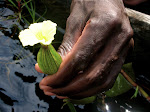
The guide squeezes this flower and it squirts water like a water pistol
Cathy and Joe Wanzala
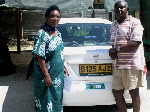
They couldn't wait to paste the Obama sticker on their car
My main man
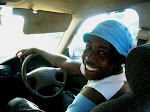
Ernest is my trusty cab driver who blasts music as we make our way through Gabs
Ted Thomas, man of intrigue and style
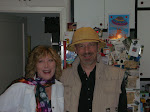
My friend, Ted, and his wife, Mary Ann, hosted a Safari Send-Off for me in Austin and treated me to a special mix of African music that already a UB student and a professor want to download.